Top SonarQube Alternatives for SAST and Code Quality
July 9th, 2026
Ben Nettleton
The best SonarQube alternatives for DevSecOps teams are tools that go beyond code quality to deliver genuine static application security testing, software composition analysis, and compliance mapping in a single platform.
The strongest options in 2026 are Kiuwan Code Security, Checkmarx, Snyk Code, Semgrep, Veracode, Coverity, GitHub CodeQL, DeepSource, and Codacy. Each fills a different gap in SonarQube’s coverage, from legacy language support to deep enterprise security analysis to AI-assisted pull request review.
This guide evaluates the leading SonarQube alternatives across five dimensions:
Analysis depth and language coverage
Security scanning capability
CI/CD and IDE integration
Remediation guidance
Pricing at scale
TL;DR
SonarQube is a code quality tool, with 85% of its rules targeting maintainability, not security. Teams that need genuine SAST, SCA, or compliance mapping end up bolting on additional tools.
The alternatives below fall into three categories: quality-first, security-first, and unified platforms that bridge both. Here’s a quick snapshot before we go deeper:
Tool
Category
Best for
Kiuwan Code Security
Unified SAST + SCA + quality
Teams needing security and quality coverage, including legacy language support
Checkmarx
Security-first
Large enterprises with mature AppSec programs and dedicated security teams
Snyk Code
Security-first
Developer-led teams prioritizing open-source risk and IDE-integrated feedback
Semgrep
Quality + lightweight security
Teams with engineering capacity to write and maintain custom rules
Veracode
Security-first
Regulated industries needing comprehensive SAST, DAST, and SCA coverage
Coverity
Quality + safety analysis
Safety-critical C and C++ codebases in automotive, aerospace, or medical
GitHub CodeQL
Security + quality
GitHub-native teams wanting customizable semantic analysis
Codacy
Quality-first
Teams prioritizing fast setup and automated code review over deep security
DeepSource
Quality + AI review
Quality-focused teams who want AI-assisted pull request review with per-seat pricing
The right choice depends on whether your primary need is code quality, security coverage, or a single platform for both.
Why teams look for SonarQube alternatives
SonarQube’s strength is code quality, prioritizing readability, maintainability, and technical debt tracking.
For teams whose primary concern is security, that focus creates gaps. The Community Edition doesn’t include taint analysis, a technique that traces attacker-controlled data through application logic to identify injection vulnerabilities.
Teams that need OWASP Top 10 coverage, CVE detection, or compliance mapping against PCI-DSS or CWE standards often end up assembling a stack of complementary tools rather than working from a single platform.
Cost is the second pressure point. SonarQube’s Community Edition is free and open source, but it is limited to single-branch analysis, with no pull request decoration and no taint analysis for injection vulnerabilities. The paid Developer Edition starts around $150 per year for 100,000 lines of code and scales to roughly $65,000 per year at 20 million lines, while the Enterprise Edition starts at $20,000 per year. Because licensing is tied to codebase size rather than headcount, teams that acquire legacy code or merge repositories can see renewal bills jump unpredictably at every cycle.
The decision framework that other guides sharing SonarQube alternatives miss is the distinction between these three categories:
Quality-first tools (e.g., SonarQube, DeepSource, Codacy) prioritize code health metrics over security depth.
Per-project vs. per-user pricing, Community vs. Enterprise tier gaps, and professional services requirements
With those dimensions in mind, here’s how the leading alternatives compare.
Compare the 9 leading SonarQube alternatives
Each of the tools below addresses a different gap left open by SonarQube, whether that’s security depth, language coverage, developer experience, or the ability to handle both quality and security without a separate toolchain. Here’s how they compare.
1. Kiuwan Code Security
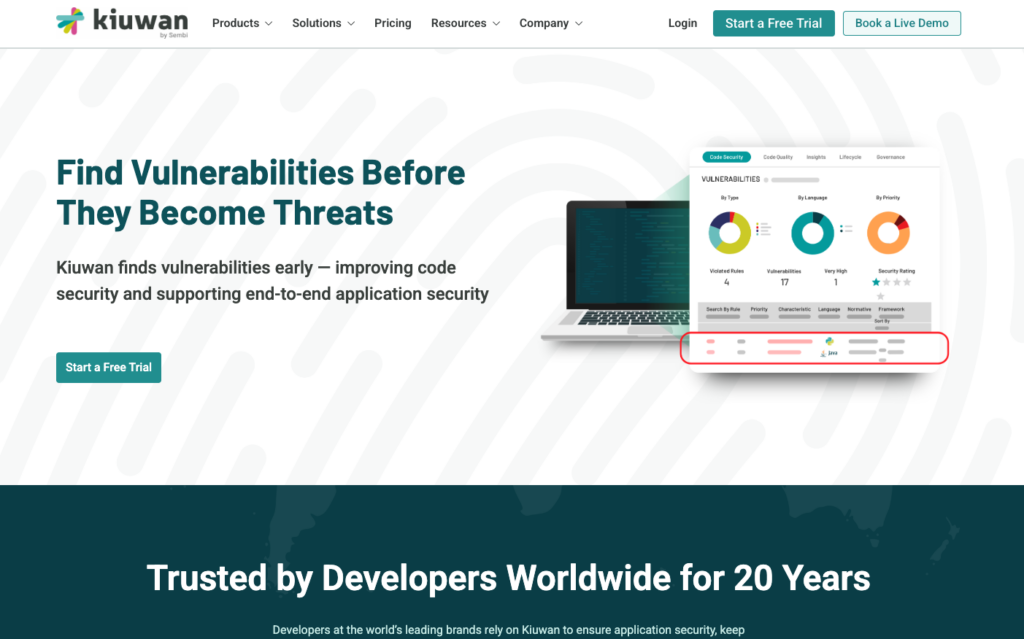
Kiuwan Code Security is a unified SAST and SCA platform designed for teams that need security coverage and code quality analysis without managing separate tools.
It supports 30+ programming languages, including legacy stacks (such as COBOL, RPG, and ABAP) that most modern security tools don’t cover, making it a practical choice for enterprises with mixed or aging codebases.
Kiuwan maps findings directly to OWASP, CWE, and PCI-DSS standards and generates prioritized action plans with code-level remediation guidance.
Its G2 ease-of-setup score of 8.9/10 compares favorably to more complex enterprise tools, and its pricing is accessible without requiring professional services engagements to get started. For teams evaluating SAST tools across both security and quality dimensions, Kiuwan is one of the few platforms that doesn’t force a tradeoff between the two.
Combined SAST and SCA in a single platform
30+ languages, including COBOL, RPG, and ABAP
Compliance mapping to OWASP, CWE, and PCI-DSS
Prioritized action plans with code-level fix guidance
CI/CD plugins for Jenkins, GitHub, GitLab, and Azure DevOps
8.9/10 G2 ease-of-setup rating
2. Checkmarx
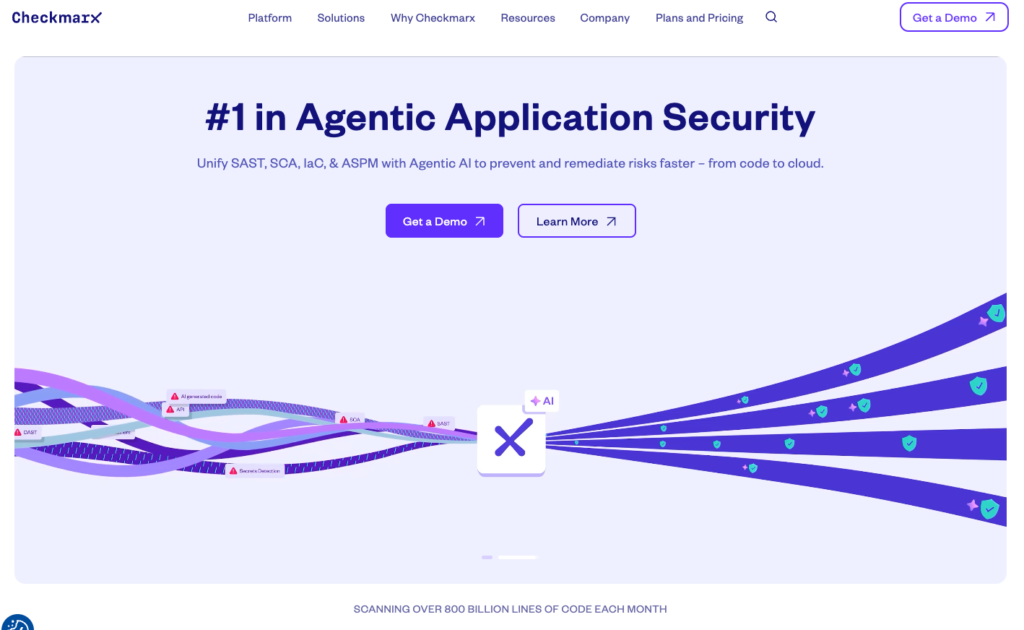
Checkmarx is an enterprise-grade SAST platform with deep taint analysis and broad language support. It’s a strong fit for large organizations with mature AppSec programs and the resources to configure and maintain a complex tool. Setup requires professional services in most enterprise deployments, and pricing reflects that positioning.
Checkmarx covers SAST, SCA, and IaC scanning within its platform, making it a consolidated option for security-focused teams. Its remediation guidance is detailed but can be verbose for development teams without dedicated security engineers to triage output.
A complex setup that typically requires professional services
Enterprise pricing model
3. Snyk Code
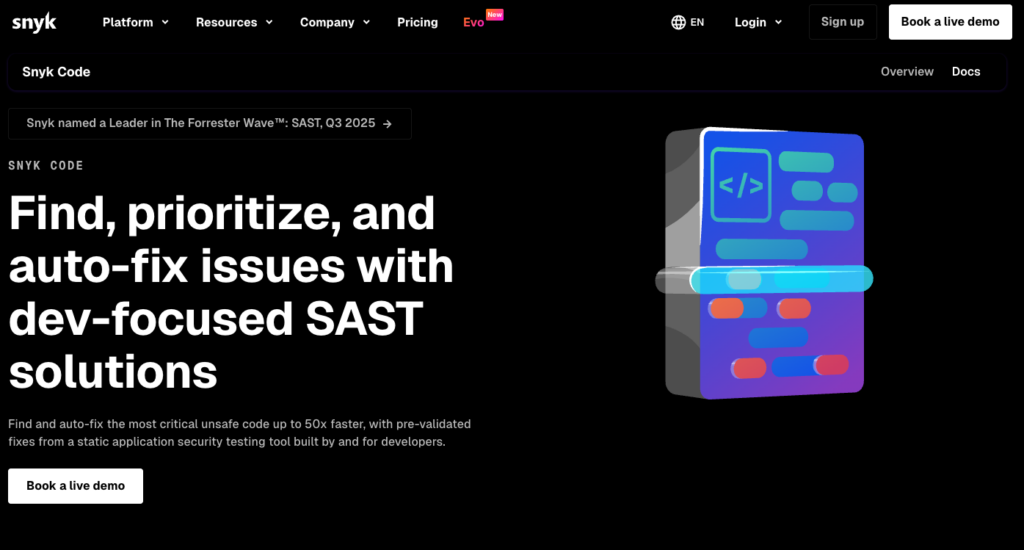
Snyk Code is a developer-focused SAST tool built for speed and IDE integration.
It’s designed to surface security findings in the developer’s workflow rather than in a separate security dashboard, which makes adoption easier in teams where security is a shared responsibility rather than a dedicated function.
Snyk’s strength lies in its SCA capabilities.
Its open-source vulnerability database is one of the most comprehensive available. SAST depth is improving, but it still trails dedicated security platforms in handling complex vulnerability patterns.
Snyk Code suits teams that prioritize developer experience and open-source risk management over deep enterprise security coverage. Teams evaluating Snyk competitors will find it strong on SCA and developer UX but lighter on SAST depth.
Developer-first SAST with strong IDE integration
Best-in-class SCA with a comprehensive open-source database
Fast scan times optimized for developer feedback loops
Combines SAST, SCA, and secrets detection
SAST depth trails dedicated enterprise platforms
Per-developer pricing that scales with team size
4. Semgrep
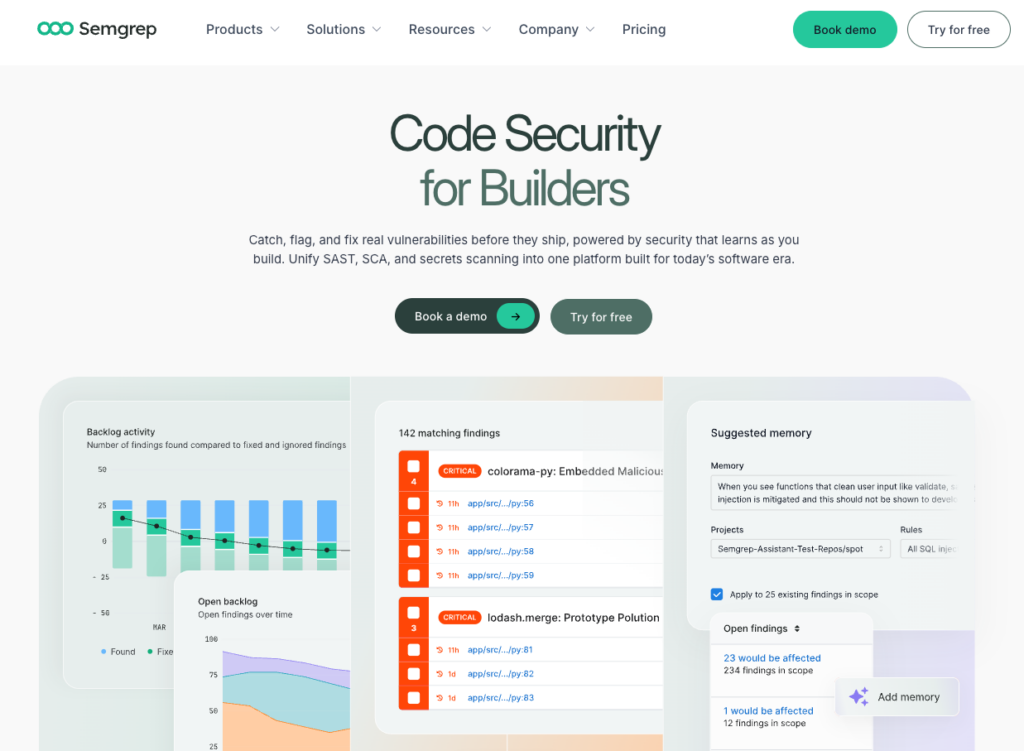
Semgrep is an open-source static analysis tool that uses a pattern-matching engine that developers can extend with custom rules. Its community rule registry is extensive, and its speed makes it well-suited for high-frequency CI/CD integration.
The open-source version is free; the commercial tier adds managed rules, triage workflows, and support.
The tradeoff is that Semgrep’s effectiveness scales with the quality of the rules applied.
Out-of-the-box coverage is good but not comprehensive for complex vulnerability patterns, such as taint-tracked injection flaws. Teams that have the engineering capacity to write and maintain custom rules get the most from it.
Open-source core with a commercial tier available
Fast pattern-matching engine optimized for CI/CD
Extensive community rule registry
Developer-extensible with custom rules
SAST depth is dependent on rule quality
Strong IDE and pipeline integration
5. Veracode
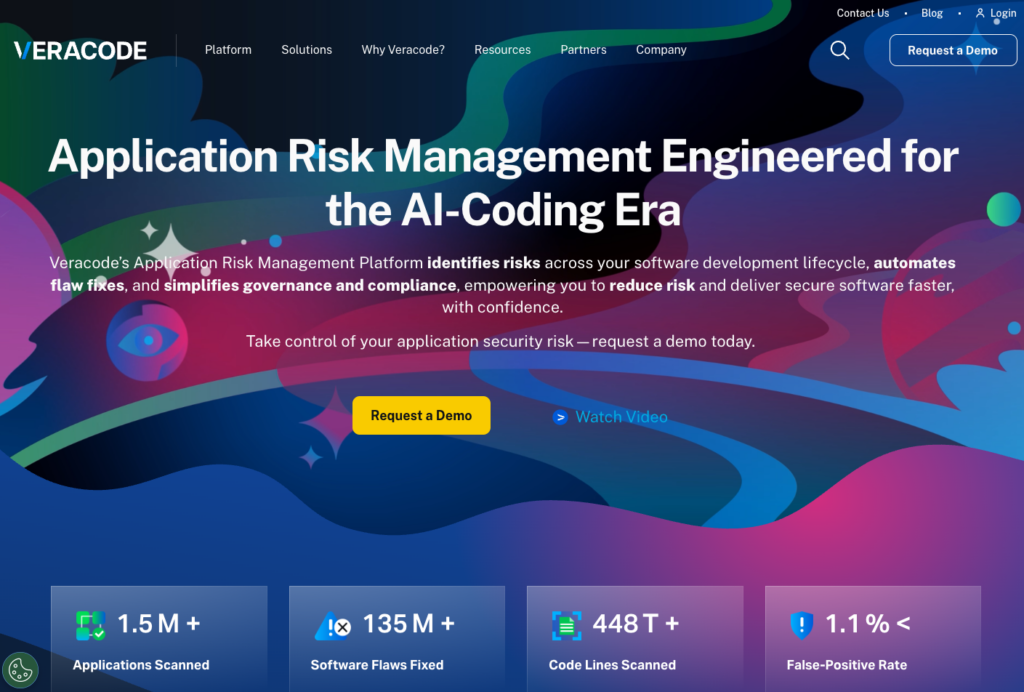
Veracode is a cloud-based application security platform covering SAST, DAST, SCA, and penetration testing. It’s one of the most comprehensive security platforms available and is widely used in regulated industries where breadth of coverage and compliance reporting are non-negotiable requirements.
Its scanning model (which submits binaries for cloud-based analysis) introduces latency that can slow CI/CD feedback loops.
Pricing is enterprise-level and typically includes professional services. Veracode suits organizations that need comprehensive security coverage and have the budget and processes to support a heavyweight platform.
Cloud-based SAST, DAST, SCA, and penetration testing
Broad compliance reporting for regulated industries
Binary scanning model with no source code required
Strong support and a professional services ecosystem
Scan latency can slow CI/CD feedback loops
Enterprise pricing with professional services expectation
6. Coverity (Synopsys)
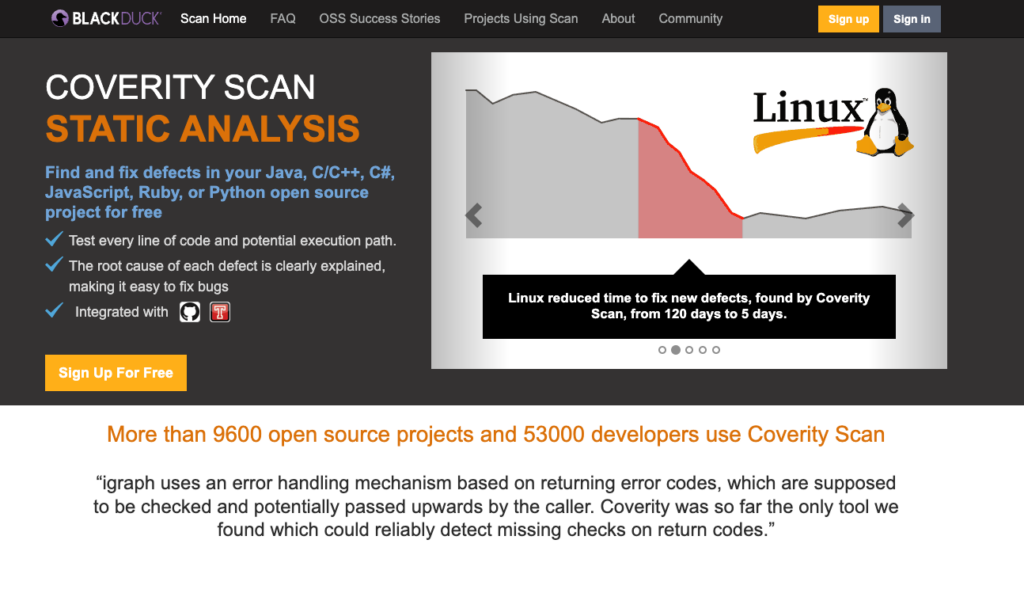
Coverity is a static analysis tool with a long track record in industries where code quality and safety are critical, including automotive, aerospace, medical devices, and financial services.
Its analysis engine is among the most thorough available for C and C++ codebases, with low false-positive rates that reduce triage burden.
It’s less suited to web application stacks or teams working primarily in modern languages like TypeScript or Go. Coverity is purpose-built for safety-critical code analysis rather than general DevSecOps, and its pricing and complexity reflect that specialization.
Deep static analysis for C, C++, and safety-critical codebases
Low false-positive rates
Strong track record in automotive, aerospace, and medical device software
Compliance support for functional safety standards
Less suited to modern web application stacks
Enterprise pricing and complexity
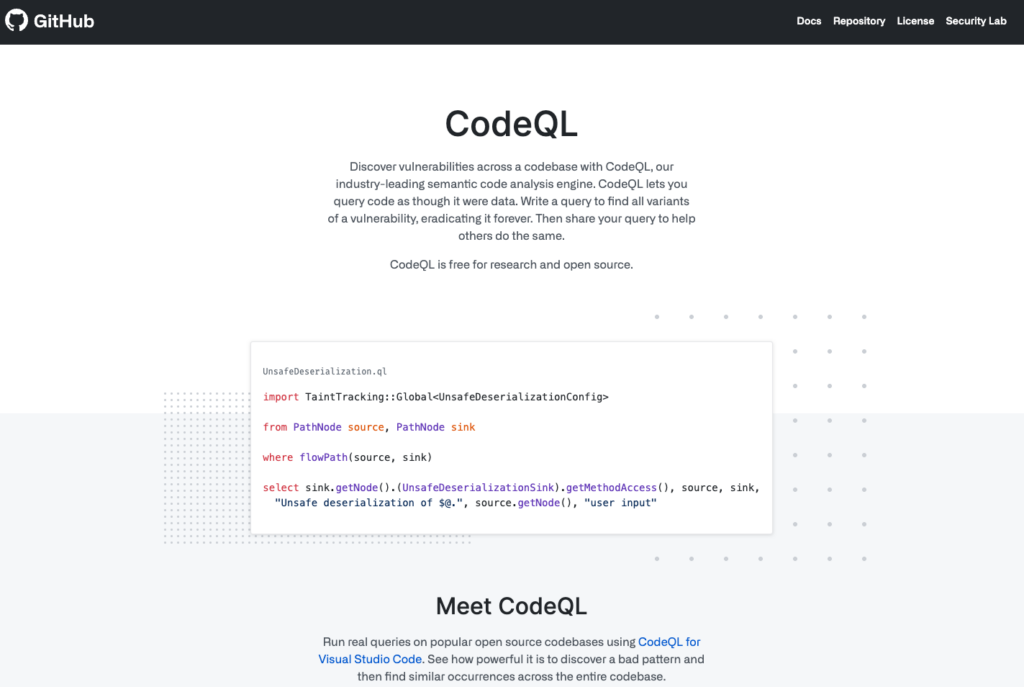
7. GitHub CodeQL
CodeQL is GitHub’s semantic code analysis engine, available free for open-source projects and included in GitHub Advanced Security for enterprise users.
It uses a query language that enables teams to write custom vulnerability-detection logic, and its integration with GitHub Actions makes it a natural fit for teams already in the GitHub ecosystem.
Its effectiveness depends on the quality of queries applied. The default query suite covers common vulnerability classes well, but complex taint analysis requires custom query development. For teams outside the GitHub ecosystem, the integration advantage largely disappears.
Free for open-source, included in GitHub Advanced Security
Semantic analysis with customizable query language
Native GitHub Actions integration
Strong community query library
Effectiveness scales with query quality
Best suited to GitHub-native workflows
8. Codacy
Codacy is a code quality platform covering style, complexity, duplication, and security. It integrates with GitHub, GitLab, and Bitbucket and offers a fast setup with minimal configuration, making it accessible to teams that want automated code review without a complex rollout.
Its security coverage is more limited than dedicated SAST platforms.
Codacy sits firmly in the quality-first category: it’s a strong choice for teams whose primary concerns are code health and developer feedback speed, but a weaker choice for teams with serious security requirements.
Fast setup with minimal configuration
Code quality, style, and complexity analysis
Integrates with GitHub, GitLab, and Bitbucket
Lightweight security scanning
Limited SAST depth compared to security-first tools
Developer-friendly pricing and interface
9. DeepSource
DeepSource is a hybrid static analysis platform that pairs a deterministic rule engine with an AI review agent on every pull request. It positions itself as a direct SonarQube replacement, with no separate CI integration to maintain and per-user pricing instead of LOC-based licensing.
It covers 16 languages at general availability, with C/C++, Swift, and Kotlin still in beta. Autofix automatically generates remediation pull requests, and false-positive rates tend to be lower than those of rule-based scanners alone, which matters for teams that have lost trust in noisy quality gates.
Where DeepSource falls short is breadth. Language coverage is narrower than SonarQube’s, quality gate enforcement is less granular, and there is no DAST or container scanning. For quality-first teams who want an AI review built in at predictable per-seat pricing, it is one of the cleaner direct replacements available.
Hybrid engine combining 5,000+ rules with an AI review agent
Native pull request integration without CI configuration
Free tier for open-source projects
Narrower language coverage than SonarQube, no DAST or container scanning
Choosing the right SonarQube alternative for your team
The right SonarQube alternative depends on what you’re actually trying to solve. Here’s how to match the tool to your team’s requirements:
Team profile
Best fit
Security-first, enterprise scale
Checkmarx or Veracode
Developer experience priority
Snyk Code or Semgrep
Safety-critical C/C++ codebases
Coverity
GitHub-native workflows
CodeQL
Code quality focus, lightweight security
Codacy or DeepSource
Unified SAST + SCA + legacy language support
Kiuwan Code Security
The teams that struggle most with SonarQube replacements are those that try to solve a security problem with a quality tool, or vice versa.
If you need both, the open-source security management that comes with unified SAST and SCA on a single platform is harder to replicate by assembling point solutions.
How Kiuwan Code Security compares
Most SonarQube alternatives force you to choose between depth and simplicity, security and quality, or modern stacks and legacy support.
Kiuwan Code Security is built for teams that can’t afford to compromise on any of those dimensions.
It combines static application security testing, software composition analysis, and code quality analysis in a single platform, with CI/CD integration that fits into existing DevSecOps workflows without a lengthy professional services engagement.
For enterprises running mixed codebases that include COBOL, RPG, or ABAP alongside modern languages, it’s one of the only platforms that covers the full stack. Here’s what that looks like in practice:
Combined SAST and SCA in one platform with no separate tools to manage or reconcile
30+ language support, including legacy stacks that most alternatives don’t cover
Compliance mapping to OWASP, CWE, and PCI-DSS; built into every scan
Prioritized action plans with code-level remediation guidance that developers can act on immediately
CI/CD plugins for Jenkins, GitHub, GitLab, and Azure DevOps for seamless pipeline integration
Accessible pricing that doesn’t require professional services to get started
If your team is ready to move beyond patching SonarQube’s gaps with additional tools, request a Kiuwan trial to see how unified SAST and SCA fit your workflow.
Frequently asked questions about switching from SonarQube
Is SonarQube free for commercial use?
SonarQube Community Edition is free and open-source, including for commercial use. It is missing taint analysis, pull request decoration, and multi-branch analysis, which most professional teams need. Adding any of those capabilities means upgrading to the Developer Edition, starting at roughly $150 per year for 100,000 lines of code, with pricing scaling by codebase size from there.
What is the best free SonarQube alternative?
Semgrep Community Edition is the strongest free option for security-focused teams, covering 30+ languages, 2,000+ community rules, and a permissive free tier. GitHub CodeQL is free for public repositories and offers deeper semantic analysis. For code quality, Codacy and DeepSource both run free tiers for open-source projects. None of them match SonarQube’s full feature set on their own, so most teams that go free combine two or three of them.
How do I migrate from SonarQube to another tool?
There is no general data migration path between SonarQube and most alternatives. Project history, issue comments, and false-positive markings stay in SonarQube unless you export them manually. The standard approach is to run the new tool in parallel for two to four weeks on active branches, recreate quality gate thresholds in the new platform, and only decommission SonarQube once the replacement is producing trusted results in pull requests.
What is the difference between SonarQube and Snyk?
SonarQube is primarily a code quality platform with lightweight security scanning, with most rules focusing on maintainability rather than security. Snyk is a security-first platform with strong software composition analysis and a developer-focused workflow, but lighter coverage of code health metrics. Teams that use both typically keep SonarQube for code quality and add Snyk for open-source dependency and container scanning.
Can one tool replace SonarQube entirely?
For teams who only need code quality, Codacy or DeepSource cover the bulk of what SonarQube does without the LOC pricing. For teams that need both quality and security in one platform, Kiuwan Code Security is one of the few options that combines SAST, SCA, and code quality coverage. It supports legacy languages such as COBOL, RPG, and ABAP that SonarQube and most modern alternatives do not. Most other replacements work best as part of a layered stack with a security tool alongside a quality tool.
Get Your FREE Demo of Kiuwan Application Security Today!
Identify and remediate vulnerabilities with fast and efficient scanning and reporting. We are compliant with all security standards and offer tailored packages to mitigate your cyber risk within the SDLC.
Java source code security scanning tools differ in how deeply they analyze application data flows, how well they understand common Java frameworks, and how easily they fit into development workflows.…
A developer adds a dependency mid-sprint to solve a routing problem. It works, the pull request merges, and the team moves on. Four days later, a CVE is disclosed against…
Every October, the Cybersecurity and Infrastructure Security Agency (CISA) leads Cybersecurity Awareness Month, an annual effort to strengthen cybersecurity and protect the systems we rely on. This year’s theme, “Securing…