AI-assisted development has changed how quickly teams can produce code, but it has not changed the security standards code must meet.
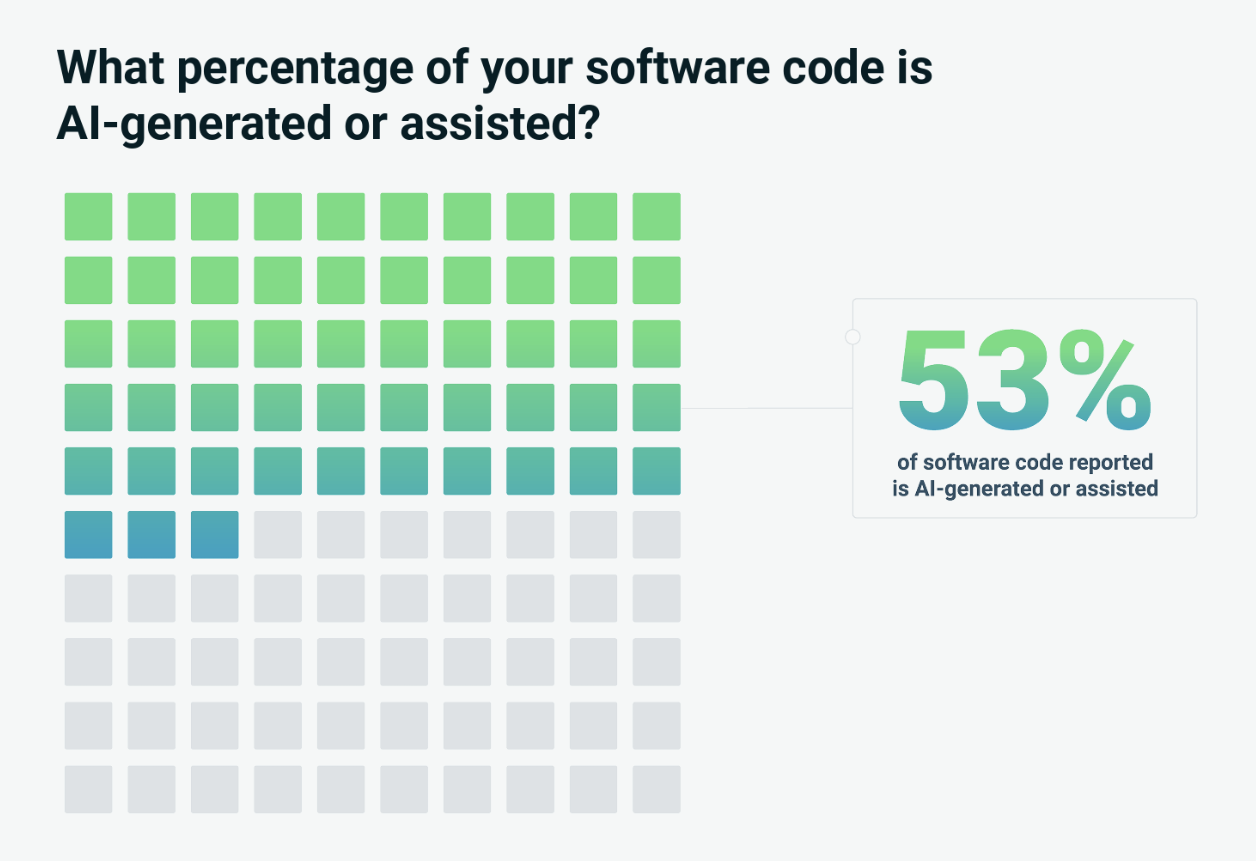
According to the Sembi Software Quality Pulse Report, respondents estimate that, on average, 53% of their organization’s code is now AI-generated or AI-assisted.¹ At that level of adoption, security teams have more code changes to evaluate within the same development and release cycles.
Image: Sembi Software Quality Pulse Report, First Edition, 2026
The OWASP Top 10 remains a useful framework for that work. An injection vulnerability is still an injection vulnerability whether the affected code was written by a human or suggested by an AI coding assistant. The same principle applies to broken access control, weak authentication, insecure dependencies, and other established application security risks.
The challenge is not that scanners need a separate way to interpret AI-generated code. It is that familiar weaknesses may now appear across a larger volume of code, making consistent review and reporting more important.
The OWASP Top 10 still applies
The OWASP Top 10:2025 identifies ten critical web application security risks:²
Broken Access Control
Security Misconfiguration
Software Supply Chain Failures
Cryptographic Failures
Injection
Insecure Design
Authentication Failures
Software or Data Integrity Failures
Security Logging and Alerting Failures
Mishandling of Exceptional Conditions
These categories describe weaknesses or control failures in an application, not how the code was written. Security teams can continue mapping weaknesses in AI-assisted code to established OWASP categories and Common Weakness Enumeration identifiers.
AI-generated code should not be confused with applications that use AI or large language models as part of their functionality. Those applications may also need to consider the separate OWASP Top 10 for LLM Applications, while the standard OWASP Top 10 continues to apply to the underlying web application.
What changes with AI-assisted development is scale. Coding assistants can quickly generate functions, endpoints, configurations, and dependency recommendations. If a developer accepts an insecure suggestion, the same pattern may recur across several parts of an application.
That does not make AI-assisted code inherently insecure. It does increase the importance of applying existing security controls consistently.
The Sembi report found that 19% of respondents selected AI-generated code risk as one of their top three security priorities.³ This concern focuses on risks introduced during development, including insecure patterns, vulnerable dependencies, incomplete validation, or code that functions correctly but does not meet the organization’s security requirements.
Which OWASP categories deserve closer review?
There is no universal ranking of which OWASP categories appear most often in AI-generated code. Results vary by language, model, prompt, framework, and application architecture. A more practical approach is to examine where generated code may introduce or repeat familiar weaknesses.
AI coding assistants can generate functional endpoints without fully understanding an application’s authorization model. A function may confirm that a user is signed in without verifying whether that user should be allowed to access a particular record, account, or administrative action.
Reviews should confirm that authorization is enforced on the server for every protected action, particularly across APIs, administrative functions, multi-tenant applications, and endpoints that accept user-controlled identifiers.
SAST can identify some access-control weaknesses, but business-specific authorization rules often require manual review because a scanner may not know which users should be allowed to perform each action.
Generated examples often focus on showing how a feature works rather than providing a production-ready configuration. Coding assistants may suggest permissive cross-origin resource sharing settings, verbose error messages, unnecessary features, or framework defaults that are not appropriate for the final environment.
Some insecure settings can be detected automatically, but source-code analysis should be combined with infrastructure, cloud, container, and deployment reviews. The code alone may not show how the application will be configured in production.
AI coding assistants frequently recommend third-party packages to complete development tasks. Those suggestions still need to be checked for authenticity, maintenance status, licensing requirements, known vulnerabilities, and alignment with internal policy.
A suggested package may be outdated, abandoned, unnecessary, or similar in name to a malicious package. It may also introduce several transitive dependencies that are not obvious from the generated code.
SAST evaluates proprietary code, while software composition analysis identifies open-source components, known vulnerabilities, and licensing risks. Both are needed to understand the application’s exposure.
Generated code may construct database queries, operating system commands, templates, or file paths using untrusted input. Injection vulnerabilities occur when that input reaches an interpreter without adequate parameterization, validation, or encoding.
SAST can identify many injection risks by tracing data from an untrusted source to a sensitive function. Accurate detection still depends on language support, framework awareness, rule quality, and data-flow analysis.
Developers also need to understand the application’s trust boundaries and confirm that validation is applied in the correct place.
Coding assistants may produce simplified authentication examples that do not account for secure password storage, session expiration, token validation, credential recovery, rate limiting, or protection against automated attacks.
Production applications should rely on approved identity providers and established authentication frameworks whenever possible. Custom authentication and session-management logic should receive additional review, regardless of whether it was written manually or generated with AI assistance.
Mishandling of Exceptional Conditions is a new category in the OWASP Top 10:2025. It covers improper error handling, unexpected states, logical failures, and fail-open behavior.
AI-generated code may clearly describe the successful path while using generic error handling or omitting less common failure scenarios. Teams should review how the code responds to invalid input, timeouts, unavailable services, failed dependencies, and partial transactions.
Unexpected conditions should not bypass security checks, expose sensitive information, or leave data in an inconsistent state.
How SAST maps findings to OWASP and CWE
The OWASP Top 10 is a broad consensus about the most critical security issues. SAST tools analyze source code using language-specific rules, structural analysis, and data-flow analysis. When a weakness is identified, the finding can be mapped to a CWE and then connected to an OWASP category.
For example, SQL injection can map to CWE-89 and OWASP A05: Injection. Hardcoded credentials can map to CWE-798 and A07: Authentication Failures.
This mapping gives teams a consistent way to organize and report findings. Developers can review the affected code and remediation guidance, while security managers can measure risk across applications, teams, CWEs, and OWASP categories.
SAST cannot fully test every OWASP category. Insecure Design may require threat modeling and architecture review. Software Supply Chain Failures require SCA. Security Misconfiguration may involve infrastructure settings outside the analyzed repository, while business logic and runtime issues may require dynamic testing or manual analysis.
A complete OWASP program may therefore combine SAST, SCA, dynamic testing, penetration testing, threat modeling, configuration review, and manual code review.
What OWASP mapping means for compliance
The OWASP Top 10 is not a compliance certification, but it is often used in secure-development policies, vendor assessments, audit preparation, and regulatory control programs.
Mapping findings to OWASP and CWE helps organizations demonstrate which weaknesses they test for, how findings are prioritized, and whether remediation improves over time. As AI increases the volume of code, automated mapping and governance reporting are easier to maintain than manual spreadsheets or one-time reviews.
The requirement remains the same regardless of how the code was written. Organizations need to demonstrate that security controls are applied consistently, findings are assigned and remediated, accepted risks are documented, and applications comply with established policies.
How Kiuwan fits
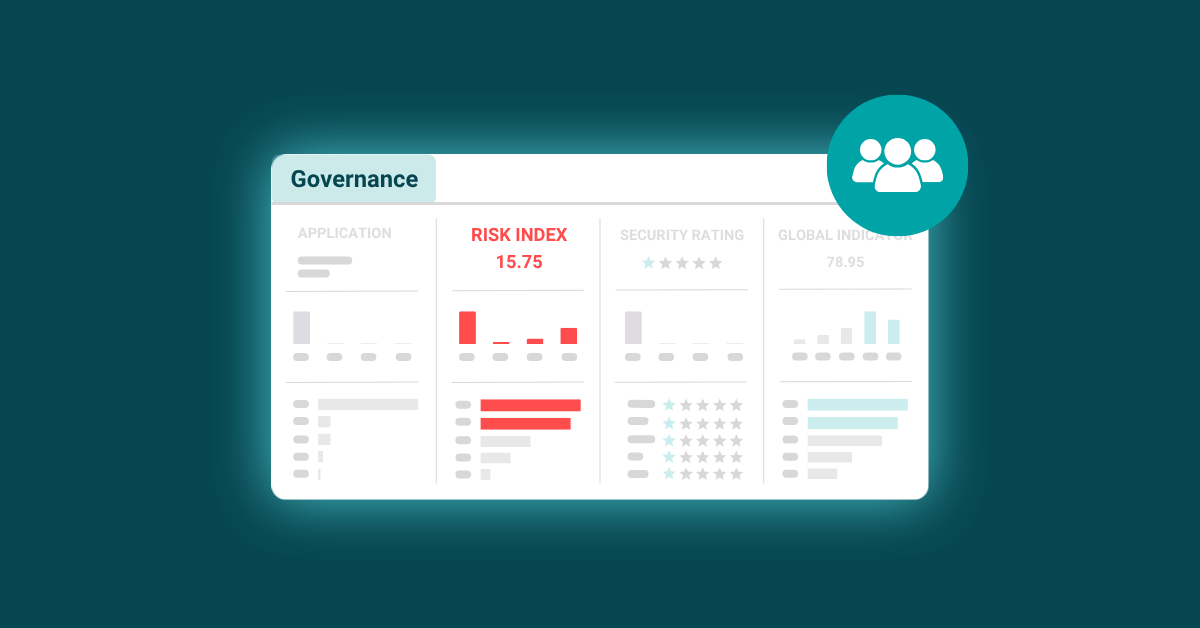
Code Security, Kiuwan’s SAST solution, has over 4,300 rules to identify source-code weaknesses and map applicable findings to CWE and other standards, including the OWASP Top 10. It supports 30+ programming languages, IDEs, and CI/CD integrations, and can be deployed on-premise or in a hybrid cloud. Kiuwan Insights provides SCA for open-source dependencies, while Kiuwan Governance provides reporting and portfolio-level visibility across applications.
Get Your FREE Demo of Kiuwan Application Security Today!
Identify and remediate vulnerabilities with fast and efficient scanning and reporting. We are compliant with all security standards and offer tailored packages to mitigate your cyber risk within the SDLC.
Every October, the Cybersecurity and Infrastructure Security Agency (CISA) leads Cybersecurity Awareness Month, an annual effort to strengthen cybersecurity and protect the systems we rely on. This year’s theme, “Securing…
Development teams often have coding standards, review requirements, and security tools, but those controls can vary significantly across applications and teams. A code governance framework connects them by defining which…
Understanding and tracking security data breaches Security data breaches are one of the biggest challenges organizations face today. Every year, companies deal with data leaks, ransomware attacks, or unauthorized access…