Java apps have at least two major attack surfaces, and many scanners are stronger on one than the other.
Proprietary code is where deserialization flaws, JNDI lookups, and weak crypto live. The Maven and Gradle dependency tree is where hundreds of transitive libraries sit, including the kind of library four hops deep that turned Log4Shell into a production incident at every Java shop in 2021.
We evaluated nine scanners on detection accuracy (OWASP Benchmark results where available), Java-specific rule depth, IDE and build-tool fit, CI/CD support, deployment options, and compliance reporting against PCI DSS, NIST SP 800-53, CWE, and OWASP Top 10.
How We Selected These Java Vulnerability Scanners
We compiled this list from G2 and Gartner Peer Insights ratings, verified user reviews, feature analysis mapped to Java AppSec requirements, and public pricing data. Every tool here supports Java static application security testing (SAST), Java software composition analysis (SCA), or both. or both. We prioritized tools with verifiable public documentation, review-site presence, or strong open-source adoption. OWASP Dependency-Check is included as an open-source utility with no commercial vendor profile.
Disclosure: Kiuwan publishes this guide and is listed below as our pick. Strengths and watch-outs for Kiuwan come from public OWASP Benchmark results and G2 verified reviews. We evaluated every tool against the same criteria.
Key Takeaways
Java vulnerability scanning needs both SAST, which checks proprietary code for issues like deserialization flaws, JNDI injection risks, and weak crypto, and SCA, which checks Maven and Gradle dependencies for known vulnerabilities. Tools that do one can leave gaps in the other.
Evaluation criteria: detection accuracy, Java-specific rule depth, IDE and build-tool fit, CI/CD support, deployment options, and compliance reporting against CWE, OWASP, PCI DSS, and NIST.
Kiuwan is the publisher’s pick: Kiuwan reported a 100% true positive rate and 16% false positive rate in its 2025 OWASP Benchmark write-up, combines SAST and SCA in one platform, and supports regulated teams that need local or hybrid analysis options.
1. Mend: Best for Java Teams That Need Automated Dependency Updates
Overview
Mend is the only tool on this list with automated dependency update workflows (via Mend Renovate). When SCA flags a vulnerable transitive Maven or Gradle dependency, the patch gets opened as a pull request instead of being added to a backlog. The platform also pairs SAST and SCA with AI-driven prioritization.
Java-specific strengths
AI-driven prioritization combines reachability, EPSS (Exploit Prediction Scoring System), and CVSS scores to cut Java SCA alert volume.
Gartner Magic Quadrant Visionary for AST (2025); 179 reviews on Gartner Peer Insights with a 4-star average.
Watch out for
Per-contributing-developer pricing covers the whole platform, which is hard to justify if you only need SCA.
Gartner reviewers (February 2026) cite scalability issues in large enterprise deployments with complex repository structures.
2. Snyk: Best for Developer-First Java Security with Fast IDE and Pipeline Feedback
Overview
Snyk pairs SAST (Snyk Code) and SCA (Snyk Open Source) in a developer-focused platform. IDE plugins and pull-request annotations flag issues before code gets merged.
Java-specific strengths
Free tier for individual developers and small teams (limited monthly test counts); Team plan from $25/developer/month.
SCA reachability analysis checks whether a vulnerable Maven or Gradle library function is actually reachable from attacker-controlled code paths, cutting down on noise.
IDE and CI/CD coverage spans IntelliJ, Eclipse, GitHub Actions, GitLab CI/CD, Bitbucket, Jenkins, and Azure DevOps. Java, Kotlin, Scala, and Groovy are all supported.
Review signal
Snyk has a strong public review-site presence across G2 and Gartner Peer Insights. Review counts and averages should be verified before publishing because they change frequently.
Watch out for
Snyk is a cloud-first platform. Enterprise plans support some self-hosted source code management integrations, but teams with strict air-gapped, on-premise, or data-residency requirements should validate the deployment model carefully.
Default SAST rules produce noise on mature Java codebases until they’re tuned.
3. Semgrep: Best for AppSec Teams That Need Customizable Java SAST Rules
Overview
Semgrep‘s rule syntax mirrors Java source code patterns, so AppSec engineers can write detection rules for proprietary frameworks and internal coding conventions that off-the-shelf rule libraries miss. Community Edition is open source and free; Semgrep Code adds taint analysis, interfile dataflow, and the Pro rule set.
The Pro Engine’s interfile taint analysis tracks source-to-sink dataflow across class boundaries, which matters for injection vulnerabilities in Spring and Jakarta EE applications where the source and sink often live in different files. Semgrep also has strong public review-site presence and has been increasingly visible in application security tooling discussions.
Watch out for
Community Edition Java rules need supplementing with custom rules for proprietary frameworks.
The managed platform is cloud-oriented, while local scanning can run in developer or CI environments. Teams that require a fully self-managed deployment should verify Semgrep’s current enterprise deployment options before standardizing.
Who should use it
Semgrep pays off most for teams with an AppSec engineer who can own rule authoring and maintenance. Teams without that resource get more out of platforms with strong default rule sets.
4. Veracode: Best for Enterprise Java Shops That Need Binary SAST
Overview
Veracode‘s SAST scans compiled Java bytecode instead of source code, which lets teams cover third-party JARs and legacy applications where source has gone missing. Gartner named it a 2025 Magic Quadrant Leader for application security testing, and it’s a regular pick in regulated enterprise environments for that reason.
Java-specific strengths
Binary SAST covers Java deserialization, JNDI injection, and weak crypto configurations without needing build system access.
Pipeline Scan is built for CI/CD gating and returns results fast enough to fail builds without slowing developers down.
Veracode has strong enterprise review-site presence, including Gartner Peer Insights. Review counts and ratings should be verified before publishing.
Watch out for
Common evaluation concerns include enterprise pricing, implementation time, and the operational work required to tune findings.
Veracode is primarily cloud-delivered. Teams needing local analysis or strict air-gapped deployment should validate whether Veracode’s deployment model fits their security requirements.
5. Checkmarx: Best for Engineering Organizations That Need SAST Plus ASPM
Overview
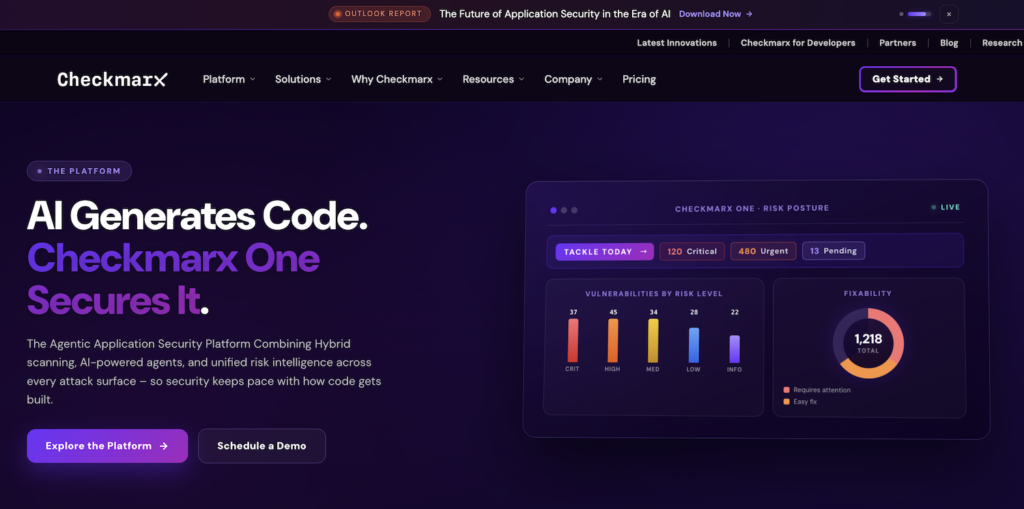
Checkmarx One bundles SAST, SCA, IaC scanning, and application security posture management (ASPM) into one platform. The ASPM piece is the differentiator for teams that need correlated risk views across many repositories. Forrester named it a Wave Leader for SAST (Q3 2025), and Gartner has put it in Magic Quadrant Leader status for AST seven years running.
Java-specific strengths
Scans more than 800 billion lines of code per month (Checkmarx 2025 figure), which keeps the Java rule set sharp across a wide range of codebases.
Source-code SAST runs without a build, so scan cycles are shorter. AI-driven agents add in-IDE remediation suggestions.
Checkmarx has strong public review-site presence. Review counts and averages should be verified before publishing.
What we like
The ASPM layer correlates SAST and SCA findings across dozens of repositories at once, which matters in microservices architectures where the same vulnerability can show up in five services with five different severities.
Watch out for
False positives come up repeatedly in G2 reviews through 2024 and 2025, especially in Kotlin and newer language scanning.
Enterprise pricing and implementation complexity may be too heavy for smaller teams.
Setup and administration can require more ownership than lighter developer-first tools.
6. SonarQube: Best for Teams That Want Code Quality and Security in One Scan
Overview
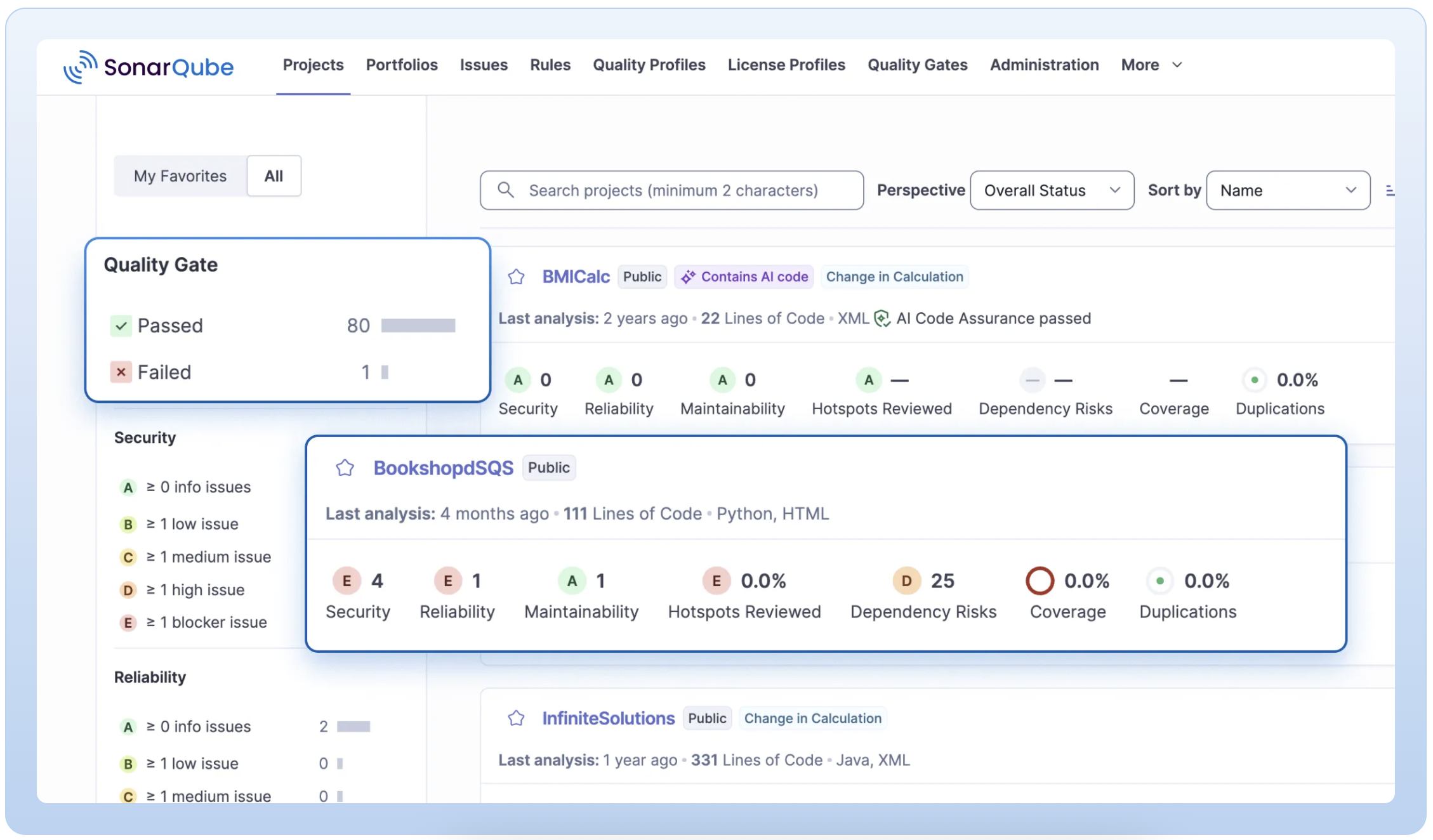
SonarQube is the most widely adopted static analyzer among Java developers, with 7 million+ users (Sonar 2025 reporting) and five straight years as a G2 Leader in static code analysis (2021-2025). The Community Build is free and open source with Maven and Gradle plugin support. The reason most teams pick it: code quality and security feedback in one scan.
When it makes sense
Development teams that want one scanner for code quality and security across Java, Kotlin, and Scala without standing up a dedicated AppSec tool. Also a strong starting point for smaller teams who need a free, Maven and Gradle-integrated option. The catch: teams facing PCI or HIPAA audits will need to map findings to specific frameworks manually. Security-first platforms like Kiuwan handle that mapping out of the box; code-quality-first tools need extra configuration.
Watch out for
SCA and license governance capabilities depend on edition and packaging. Teams evaluating SonarQube as a full SCA replacement should compare dependency depth, transitive dependency handling, and license policy enforcement against dedicated SCA platforms.
Security-specific feedback often calls out compliance mapping as an area to validate during evaluation.
7. Kiuwan: Best for Unified Java SAST and SCA in Regulated and On-Premise Environments
Overview
Scanning only proprietary code misses the majority of a modern Java application’s attack surface. Kiuwan provides both runs SAST and SCA in one platform, scanning proprietary and third-party Java code and the full Maven and Gradle dependency tree without separate tools or manual reconciliation. On-premise and hybrid-cloud deployment keep it usable in regulated environments where cloud-only tools get disqualified. Continuous scanningDaily scans picks up regressions as code changes, not just the vulnerabilities present in the initial baseline.that existed on day one.
Shift-left developer workflow. IntelliJ IDEA and Eclipse plugins flag issues while developers are writing code, not after the build runs. Jenkins, GitHub Actions, GitLab CI/CD, and Bitbucket Pipelines integrations drop into existing pipelines without rework.
Compliance-native reporting. Findings map to CWE, OWASP, PCI DSS, CERT, SANS, and NIST, so developers can see which framework a finding violates without going to AppSec. SBOM export in CycloneDX format supports Executive Order 14028 and enterprise procurement requirements.
What we like
Combining SAST and SCA in one tool removes a reconciliation problem. When two separate scanners run, the same CVE often shows up twice with different severities and conflicting remediation paths, and someone on AppSec has to sort it out by hand. One risk view across proprietary and open-source code helps simplify that workflow. Public review-site feedback can also help validate usability, but teams should pair that signal with a hands-on trial using their own codebase, rule set, and CI/CD workflow.
Watch out for.
Kiuwan has fewer public G2 reviews than some larger competitors, so teams should pair review-site feedback with a hands-on trial using their own Java codebase, rule set, CI/CD workflow, and compliance requirements.
Pricing: User-based subscription pricing; free trial available. Confirm current plan details, included features, deployment options, and how users are counted directly with Kiuwan. Free trial available.
8. GitHub Advanced Security: Best for Teams Whose Java Lifecycle Runs on GitHub
Overview
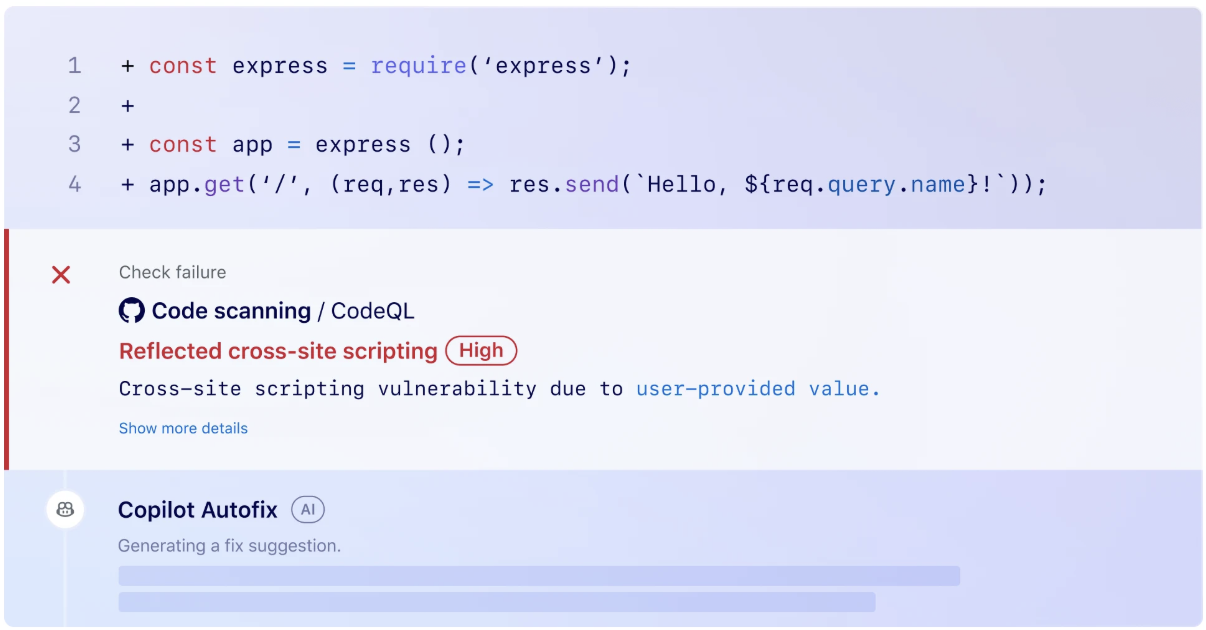
GitHub Advanced Security bundles CodeQL-powered SAST, Dependabot dependency scanning, and secret scanning into the GitHub repository interface. For teams already on GitHub Enterprise, turning on Java SAST and SCA is a repository setting. Findings show up inline in pull requests and the security tab. Gartner Peer Insights: 4.6/5 from 125 reviews.
When it makes sense
GitHub Enterprise teams that want Java SAST and SCA without buying or operating another tool. Teams running across Azure DevOps, GitLab, or Bitbucket will hit the limits of a GitHub-native architecture quickly, as will anyone who needs on-premise deployment.
Watch out for
Per-user licensing based on active committers in the past 90 days creates unpredictable cost growth in larger organizations.
Reporting is severity-heavy. Business impact context is thin compared to dedicated AppSec platforms.
9. OWASP Dependency-Check: Best for Free, Maven/Gradle-Native SCA
Overview
OWASP Dependency-Check is a longstanding open-source SCA tool for Java, scanning Maven and Gradle dependency trees against vulnerability data sources such as the NVD and CVE database through native plugin support. OWASP describes Dependency-Check as an SCA tool that detects publicly disclosed vulnerabilities by identifying Common Platform Enumeration, or CPE, identifiers and linking them to associated CVE entries.
It’s free, widely understood, and produces reports in HTML, JSON, and JUnit XML for CI/CD pipelines. With no licensing cost and no vendor relationship, it’s a common starting point for Java teams under budget constraints.
Java-specific strengths
Maven plugin and Gradle plugin support make it easy to add to Java builds.
Direct NVD and CVE integration maps Java dependencies to CVE identifiers with CVSS scores, no intermediary required.
Watch out for
No SAST. Dependency-Check covers open-source dependencies only, so proprietary Java code goes unscanned.
CPE matching can produce false positives in large Maven dependency trees, so teams should expect some triage work. Many teams layer a commercial SCA tool on top when they need stronger prioritization, reachability analysis, remediation workflows, or governance reporting.
How to Choose a Java Vulnerability Scanner
Picks vary by team size, deployment constraints, and what you’re trying to solve. The table below maps the most common scenarios.
If you are…
Recommended pick
Why
SMB with no budget
Semgrep Community Edition + OWASP Dependency-Check
Both free; together they cover Java SAST-style pattern scanning and SCA at zero licensing cost
Mid-market, developer-led
Snyk
Developer-friendly workflow, free and paid tiers, and fast feedback in IDEs and pipelines
Mid-market or enterprise, regulated
Kiuwan
Local and hybrid analysis options, Kiuwan-reported 2025 OWASP Benchmark results, and native compliance mapping across CWE, OWASP, PCI DSS, CERT, SANS, and NIST
Enterprise with legacy binaries
Veracode
Binary SAST scans compiled Java bytecode without requiring direct source access
Large engineering org, microservices
Checkmarx
ASPM-level correlated risk across many repositories
First: Do you need local or on-premise analysis for data residency, source-code handling, or air-gapped environments? If yes, prioritize tools with documented support for that constraint, such as Kiuwan, Checkmarx, self-hosted SonarQube, or carefully validated Veracode options. Kiuwan specifically documents hybrid-cloud and local analyzer options, and its docs state that with local analysis, source code remains on the local machine while encrypted results are uploaded for reporting.
Second: Are you in PCI DSS or HIPAA territory? Kiuwan maps findings to PCI DSS, CWE, OWASP, CERT, SANS, and NIST out of the box. Other tools may also support compliance workflows, but teams should validate how much setup is required to produce audit-ready reports.
Start Scanning Your Java Codebase Before the Next Audit
A scanner that covers only proprietary code, or only open-source dependencies, is doing half the job. The nine tools above span the field, from free open-source utilities to enterprise platforms with compliance-native reporting.
If you’ve sat through a PCI audit and watched a scanner produce findings that didn’t map to anything your auditors cared about, the next evaluation criterion is compliance-native reporting, not raw detection volume.
Kiuwan’s free trial runs SAST and SCA against your own Java codebase, with your own Maven or Gradle dependency tree.
The 2025 OWASP Benchmark results provide one useful accuracy signal before you commit, but the best test is still your own codebase, with your own frameworks, dependency tree, and compliance requirements.
If you want compliance-mapped findings against CWE, OWASP, and PCI DSS without additional configuration, the trial is the fastest way to verify fit against your own environment.
Frequently Asked Questions About Java Vulnerability Scanners
What is the difference between SAST and SCA for Java applications?
SAST analyzes your proprietary Java source code or bytecode for vulnerabilities like SQL injection, deserialization flaws, and risky JNDI usage. SCA scans your Maven and Gradle dependency tree for known CVEs in open-source libraries. Running only one can leave a real gap in coverage.
Do I need both SAST and SCA to scan Java applications properly?
Most production Java applications combine proprietary code with open-source libraries. A SAST-only scanner misses open-source CVEs and licensing breaches; an SCA-only scanner misses first-party code vulnerabilities. Teams managing regulated Java workloads typically need both.
Which Java vulnerability scanners support on-premise deployment?
Kiuwan offers local and hybrid analysis options for environments where source-code handling and data residency matter. Checkmarx and self-hosted SonarQube may also fit some on-premise requirements, depending on package and deployment model. Veracode is primarily cloud-delivered, so teams with strict air-gapped requirements should validate fit carefully.
Get Your FREE Demo of Kiuwan Application Security Today!
Identify and remediate vulnerabilities with fast and efficient scanning and reporting. We are compliant with all security standards and offer tailored packages to mitigate your cyber risk within the SDLC.
Every October, the Cybersecurity and Infrastructure Security Agency (CISA) leads Cybersecurity Awareness Month, an annual effort to strengthen cybersecurity and protect the systems we rely on. This year’s theme, “Securing…
Development teams often have coding standards, review requirements, and security tools, but those controls can vary significantly across applications and teams. A code governance framework connects them by defining which…
Understanding and tracking security data breaches Security data breaches are one of the biggest challenges organizations face today. Every year, companies deal with data leaks, ransomware attacks, or unauthorized access…