A Developer’s Guide to Improve Code Quality in Your Codebase
June 4th, 2026
Ben Nettleton
Key takeaways: Code quality spans five dimensions (readability, maintainability, efficiency, security, and testability), each affecting different stakeholders. Teams improve code quality through coding standards, code reviews, automated testing, and regular refactoring. Static code analysis also automates enforcement by tracking metrics like complexity and duplication. Modern platforms combine SAST, SCA, and quality governance to streamline the entire process.
Improving code quality requires combining proven development practices with automated enforcement tools.
According to Stripe’s Developer Coefficient report, developers estimate spending 13.5 hours per week on technical debt and 3.8 hours per week addressing poor code quality, for a total of 17.3 hours per week (about 42% of their work time).
This guide covers:
The five dimensions of code quality and their impact
Foundational practices: standards, reviews, testing, and refactoring
Static code analysis and key metrics to track
Tooling integration in CI/CD pipelines and IDEs
Unified platforms for SAST, SCA, and quality governance
The five dimensions of code quality
Code quality isn’t a single metric. It spans five interconnected dimensions that affect different stakeholders in different ways:
Readability: How quickly developers can understand code they didn’t write.
Maintainability: How easily you can modify code without breaking existing functionality.
Efficiency: Runtime performance and resource consumption.
Security: Vulnerabilities that could expose data or systems.
Testability: How well the code supports automated validation.
Each dimension creates its own problems. Unreadable code burns developer hours every day. Poor maintainability increases the risk of bugs reaching users. And when code is hard to test or inefficient to run, leadership sees timelines slip.
Improving code quality means addressing all five dimensions, not just the ones causing immediate friction.
Foundational practices every team needs
Before investing in tooling to improve code quality, teams need foundational practices in place. These create the baseline discipline that tools build on.
Coding standards
Coding standards maintain a consistent style across the codebase. When everyone follows the same conventions for naming, formatting, and structure, developers can read each other’s work with less cognitive friction. Standards reduce the mental load of context-switching between different coding styles. That matters more than any individual preference.
Code reviews
Code reviews catch problems early and spread knowledge across the team. A second set of eyes can spot logic errors, security gaps, and maintainability issues before they reach production. Reviews also transfer domain knowledge, expose junior developers to senior thinking, and prevent any single person from becoming a bottleneck on specific modules.
Automated testing
Automated testing validates behavior at every layer of your application. Structure tests as a pyramid: fast unit tests at the base, integration tests in the middle, and slower end-to-end tests at the top. Unit tests run in milliseconds and catch regressions quickly. Integration tests verify that components work together correctly. End-to-end tests confirm user-facing workflows but run slowly, so you typically need fewer of them. This pyramid gives you fast feedback loops without burning hours waiting for test suites to complete.
Regular refactoring
Regular refactoring keeps small annoyances from hardening into architectural problems. When you refactor continuously, you address code smells while they are still easy to fix. Wait too long, and minor issues compound into technical debt that requires major rewrites. This makes refactoring part of normal development work rather than a separate phase.
Static code analysis: The automated quality engine
Static code analysis reads your source code without executing it. It helps flag bugs, code smells, security issues, and standard violations before they reach production. Unlike manual code reviews, static analysis runs consistently across your codebase and can catch patterns humans might miss.
Key metrics to track
A few key metrics can help you track whether your codebase is getting healthier or accumulating technical debt over time:
Cyclomatic complexity
Measures how many independent paths exist through a function. Higher complexity typically means more potential bugs and harder testing, and often signals a need for refactoring.
Code duplication
Tracks repeated logic across your codebase. Higher duplication increases maintenance costs because changes and fixes must be repeated across multiple places.
Maintainability index
Combines factors like complexity, code volume, and comment density into a single score. Watching this metric over time can show whether refactoring is improving maintainability or accumulating debt.
Static analysis vs. SAST
General static analysis focuses on code health: bugs, maintainability issues, and standards violations. SAST (Static Application Security Testing) focuses on identifying security vulnerabilities.
SAST tools often use techniques like taint analysis and control flow analysis to catch issues such as:
Injection flaws
Authentication weaknesses
Insecure data handling
Other security-specific issues
Both approaches analyze code without running it, but SAST prioritizes exploitable risk while general static analysis prioritizes broader code quality and maintainability.
Automating code quality with the right tools
Static analysis works best when it’s integrated into your existing development workflow, not bolted on as an afterthought. Different tool types serve different purposes:
Injection risks, insecure cryptography, hardcoded secrets, and unsafe patterns
CI/CD pipeline integration
Integrating these tools into your CI/CD pipeline helps block problematic code before it reaches production.
When a pull request triggers your build pipeline, static analysis runs automatically. If the code violates your quality gates (for example, critical vulnerabilities, complexity thresholds, or policy violations), the build can fail. This prevents bad code from merging, rather than discovering problems weeks later.
IDE plugins
IDE plugins let developers fix issues while writing code, not days later during code review. Real-time feedback highlights problems as you type, often with suggested fixes available immediately.
This shortens the feedback loop from hours or days down to seconds, so quality enforcement feels like a helpful nudge, not a tollbooth.
Unified platforms vs. point solutions
Most teams cobble together separate tools for linting, static analysis, and security scanning. Each tool requires its own configuration, produces its own reports, and operates in its own silo. With that setup, developers waste time reconciling results, figuring out which findings matter most, and managing multiple dashboards.
Unified platforms solve this by combining SAST, SCA (Software Composition Analysis), and code quality governance into a single system. Instead of juggling multiple tools with different interfaces, teams get a single view of code health.
Kiuwan exemplifies this approach with support for 30+ programming languages, including legacy languages that specialized tools may not cover well. This lets teams standardize quality enforcement across their stack, whether they’re working in modern JavaScript frameworks or maintaining long-lived COBOL systems.
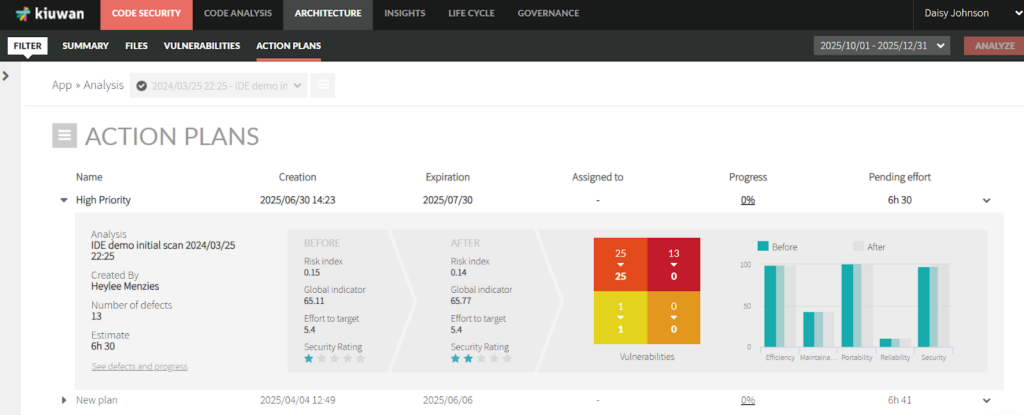
The value becomes clearer in technical debt management. Platforms like Kiuwan can prioritize fixes based on severity and estimated effort, turning a sprawling backlog into a more actionable list.
Improve code quality and reduce technical debt with Kiuwan
Code quality doesn’t have a finish line. You either reinforce it every day or watch it erode. The right tooling makes that reinforcement consistent.
SAST and SCA to identify security risks in both proprietary code and open-source components
Multi-language support across 30+ languages, including legacy codebases
Governance and reporting to help teams track progress over time and focus effort where it has the most impact
CI/CD integrations that support automated scanning and policy enforcement earlier in the delivery process
Static analysis finds the problems. Kiuwan helps you organize and act on them. Start your free trial to see how unified code quality management can reduce technical debt and support faster development.
Get Your FREE Demo of Kiuwan Application Security Today!
Identify and remediate vulnerabilities with fast and efficient scanning and reporting. We are compliant with all security standards and offer tailored packages to mitigate your cyber risk within the SDLC.
Every October, the Cybersecurity and Infrastructure Security Agency (CISA) leads Cybersecurity Awareness Month, an annual effort to strengthen cybersecurity and protect the systems we rely on. This year’s theme, “Securing…
Development teams often have coding standards, review requirements, and security tools, but those controls can vary significantly across applications and teams. A code governance framework connects them by defining which…
Understanding and tracking security data breaches Security data breaches are one of the biggest challenges organizations face today. Every year, companies deal with data leaks, ransomware attacks, or unauthorized access…