If you’re evaluating tools on their pure Static Application Security Testing (SAST) strengths, you’ll find a deep bench of Snyk competitors. Some Snyk competitors focus purely on code, some on customizability, and others specialize in unique risk types.
Each of these Snyk competitors has a distinct approach and a long list of pros and cons that may or may not align with your DevSecOps and AppSec workflows.
In this review, we’ll examine five SAST contenders:
Kiuwan
Cycode
Semgrep
Aikido
GitGuardian
We’ll look at which teams they best support, some of their standout features, the depth and breadth of their SAST scan, the languages and platforms they support, their audit and compliance postures, how they integrate with your stack, and finally, the pain points and limitations they can bring into your security lifecycle.
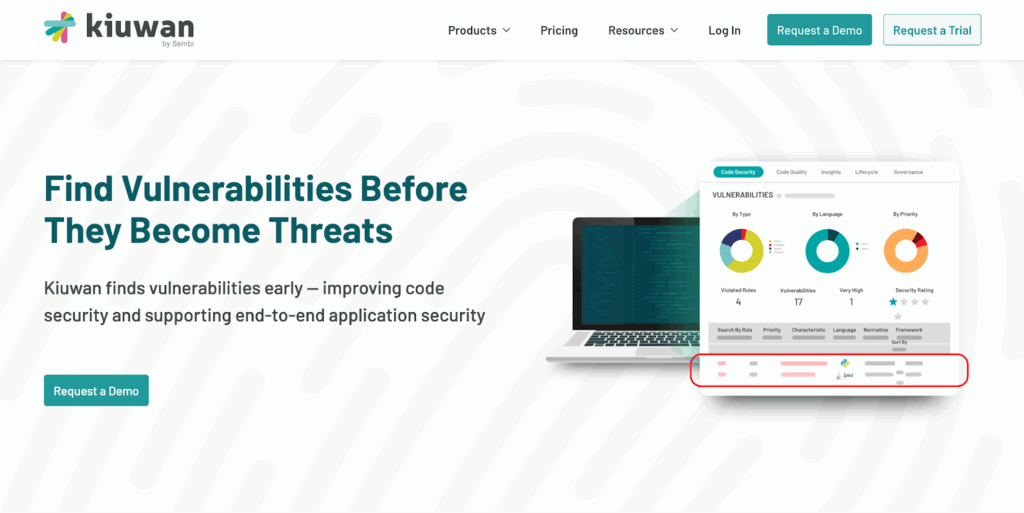
Ideal use case: Kiuwan is a Snyk competitor suited for teams carrying technical debt in heavily regulated industries with complex, legacy, and multi-language codebases.
Image: Snyk Competitor: Kiuwan
Kiuwan’s standout feature
A single quality gate system: Kiuwan fuses security and code maintainability into a unified system. This means you can set policies requiring pull requests (PRs) and merges to be free of critical vulnerabilities while meeting maintainability and style thresholds. This lets you treat maintainability and security as equally essential release criteria.
Kiuwan’s scan depth and breadth
Kiuwan uses a distributed scan engine to analyze source, bytecode, or binaries.
It scans entire application portfolios, supporting monorepo and multi-repo environments.
Its scans are policy-driven with deep taint analysis: it tracks data flow, control flow, and propagation.
It has out-of-the-box detection for injections, misconfigurations, business logic flaws, and insecure error handling, but depth increases when you tune for your app’s architecture.
Differential/incremental scanning focuses on newly changed code in big monorepos or CI pipelines.
Kiuwan’s audit, reporting, and compliance mapping
Automated mappings for NIST, CWE, MISRA, PCI DSS, OWASP, SANS Top 25, HIPAA, WASC, BIZEC, ISO 25000, ISO 9126, CERT-C, and CERT-J.
Reports are generated for every analysis, including defect counts, distributions (by severity, type, and language), policy violations, technical debt, and risk ratings.
Custom reports and dashboards let you slice by team, repo, defect class, or compliance status using a reporting widget library.
All audit/reporting data is available via the UI but can be exported (PDF/CSV) or pulled via API for integration with external compliance or analytics tools.
Kiuwan’s supported languages, platforms, and frameworks
Kiuwan supports over 30 languages, including Java, .NET, C/C++, COBOL, and PHP.
Linux, Windows, macOS (via IDE and CLI tools), Docker, AWS, Azure, IBM Bluemix DevOps, CloudBees, and WordPress.
GitHub, GitLab, Bitbucket, Azure DevOps, Jenkins, Jira, Bamboo, CircleCI, TeamCity, IBM UrbanCode, Microsoft TFS/VSTS, CloudBees, Visual Studio, Eclipse, IntelliJ IDEA, PyCharm, VS Code, Ranorex, PreEmptive, ServiceNow, OAuth2/OIDC SSO (Okta, ADFS, etc.), REST API, and WordPress.
Kiuwan’s pain points and limitations
Default rulesets can create high alert volume and false positives before you tune your policies.
Snyk competitor #2: Cycode
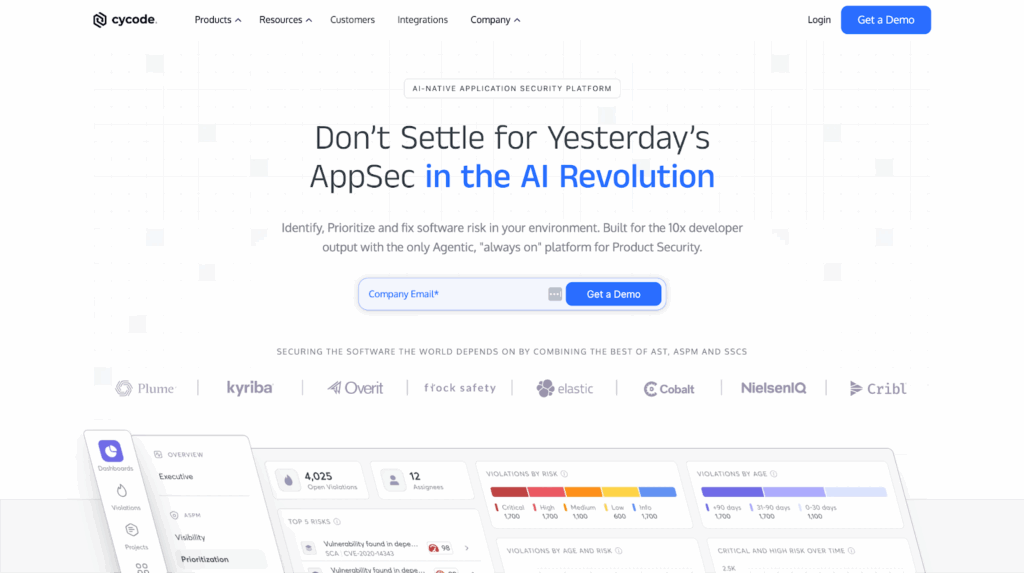
Ideal use case: Cycode is a Snyk competitor offering code-to-runtime visibility with live telemetry risk correlation and deep AI prioritization mapped from static code to live behavior. It’s well-suited for enterprise teams needing supply chain security.
Image: Snyk Competitor: Cycode
Cycode’s standout feature
Proprietary “Always-On” AST engine: Cycode’s SAST engine traces dynamic inputs across multiple functions and files, mapping how that data flows through code. The engine runs automatically on every code change and commit, surfacing vulnerabilities directly in PRs.
Additionally, the engine produces fully visualized evidence paths where you can see how the issues propagate.
Cycode’s scan depth and breadth
Cycode’s SAST engine traces user and system data across all functions, files, and modules, mapping every source-to-sink path.
Proprietary algorithms detect hardcoded secrets across code, build logs, CI/CD configs, artifact stores, and cloud settings.
Every code change triggers a scan, and you can also retroactively scan old commits, binaries, and artifacts.
Cycode’s audit, reporting, and compliance mapping
Maps to FedRAMP, DORA, ISO 27001, PCI DSS, HIPAA, NIST SSDF, SOC 2, GDPR, CCPA, SOX, CIS Controls, NYDFS, COBIT, FISMA, and HITRUST CSF.
Cycode generates Software Bill of Materials (SBOMs) in SPDX and CycloneDX formats. SBOMs can include vulnerability data and license info.
Generates detailed vulnerability and remediation reports.
Offers live continuous monitoring dashboards.
Cycode’s supported languages, platforms, and frameworks
Real-time, cross-repo scanning can tax resources and may slow feedback cycles unless you optimize settings for incremental or partial scans.
Most runtime risk and AI-powered exploitability functions are reserved for enterprise tiers.
Snyk competitor #3: Semgrep
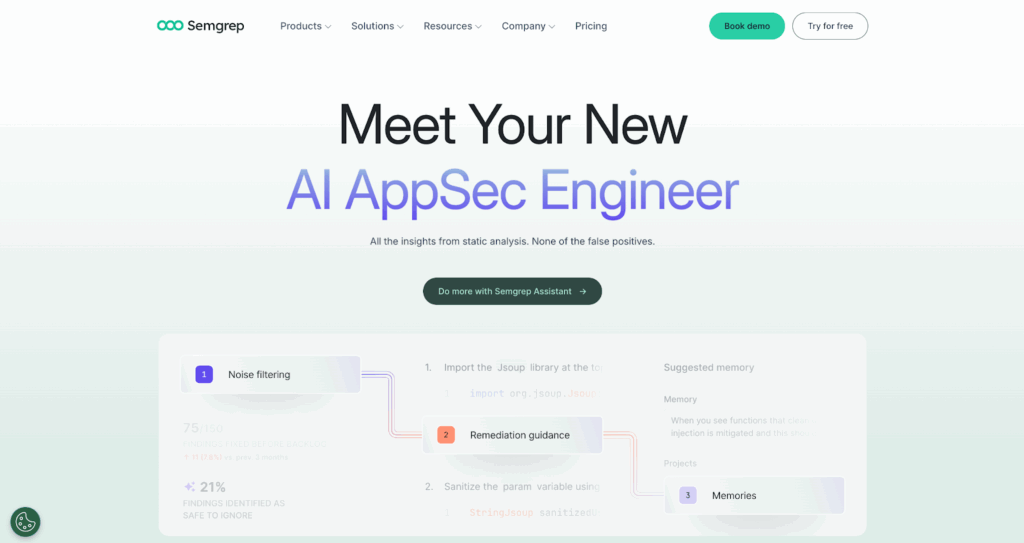
Ideal use case: Semgrep is a Snyk competitor focusing on custom rule creation and flexible policy enforcement for teams looking for fast, developer-friendly SAST.
Image: Snyk Competitor: Semgrep
Semgrep’s standout feature
YAML-based rule engine: This lightweight engine lets you write, adapt, or extend rules to match real code patterns like syntax, bad APIs, business logic, or project-specific anti-patterns.
Both your custom rules and the rules you import from the Rules Marketplace are fully portable and reusable across projects and deployments.
Semgrep’s scan depth and breadth
Semgrep focuses on fast, file-level pattern matching in real languages, not regex, for catching injections, hardcoded secrets, basic misconfigs, and project-specific anti-patterns.
Its rules do not perform inter-procedural or deep taint tracking, and complex multi-file or dynamic flows are out of scope.
Semgrep’s audit, reporting, and compliance mapping
Maps to internal checklists, OWASP Top 10, CWE, PCI DSS, NIST SSDF, NIST CSF, HIPAA, SOC 2, ISO/IEC 27001, FedRAMP, GDPR, MITRE ATT&CK, and CIS Benchmarks.
Reports are exportable as JSON/CSV, and you can access cloud dashboards for policy status, rule usage, and scan results.
Semgrep’s supported languages, platforms, and frameworks
GitHub, GitLab, Bitbucket, Jenkins, CircleCI, Slack, VS Code, JetBrains, CLI, and REST API.
Semgrep’s pain points and limitations
There is no true data flow, and the engine will not find vulnerabilities that jump across multiple files or functions.
Real signal depends on continuous rule curation. The default community rules can be noisy, so you need to tune for your stack.
Large repos or tightly integrated monoliths may push local runner limits, requiring cloud or offloaded execution.
Snyk competitor #4: Aikido
Ideal use case: Aikido is a newer Snyk competitor focused on streamlining SAST for smaller cloud-native teams and startups prioritizing low-friction security.
Image: Snyk Competitor: Aikido
Aikido’s standout feature
Low-noise scanning: Aikido delivers curated rulesets maintained by its team. The scans focus on critical security vulnerabilities and avoid flagging cosmetic or non-exploitable issues. This reduces alert volume, and you can expect scan results that surface only high-confidence findings tied to your app’s language and framework.
Aikido’s scan depth and breadth
Aikido’s SAST rules focus on high-impact vulnerabilities like common injections (SQL, NoSQL, command), deserialization, SSRF, path traversal, privilege escalation, and insecure configs.
By default, the engine avoids reporting style, code quality, or “info only” issues.
There’s no support for custom patterns, organization-specific checks, or deep policy tuning.
Its scans are primarily syntax and pattern-based, with some semantic context for simulating real data and control flow.
There’s no taint analysis or inter-procedural (multi-function/multi-file) tracking for deeply chained vulnerabilities, which limits the tool’s efficacy in finding multi-step exploits or vulnerable flows in large, distributed codebases.
By default, it runs on every commit, PR, or MR and has fast scan times. Results are annotated directly in the VCS.
Differential scanning on the newly modified code.
Aikido’s supported languages, platforms, and frameworks
Ubuntu, Debian, CentOS, Fedora, Red Hat Enterprise Linux (RHEL), Alpine, Amazon Linux, and Git providers.
Aikido’s audit, reporting, and compliance mapping
Maps to OWASP Top 10, CWE, PCI DSS, NIST SSDF/CSF, HIPAA, SOC 2, ISO/IEC 27001, FedRAMP, GDPR, MITRE ATT&CK, and CIS Benchmarks.
Dashboards and exportable reports tie findings and status to compliance frameworks.
Organization-wide trends, risk heatmaps, and user attribution reports are restricted to paid plans.
Real-time SIEM, SOAR, or advanced audit exports require custom workarounds.
Aikido’s integrations
Integrates with mainstream Git and CI platforms.
Aikido’s pain points and limitations
Aikido has limited framework awareness. Coverage is best for major, mainstream frameworks.
Aikido only scans human-readable source code, and there are no compiled binaries, minified code, or mixed-build artifacts for analysis.
Snyk competitor #5: GitGuardian
Ideal use case:GitGuardian is a tool that automates secrets detection in multi-repo and multi-developer environments. It is best for teams needing real-time secrets detection across distributed source code.
Image: Snyk Competitor: GitGuardian
GitGuardian’s standout feature
GitGuardian’s specialized secrets detector is a real-time, automated engine that scans code for over 350 types of sensitive credentials using pattern recognition. It has two primary algorithms:
Specific detectors: These algorithms focus on one secret type at a time. You get coverage for 450 patterns of mainstream, third-party, and obscure keys. It natively understands multi-line secrets, and can extract compound values from structured text in source or config files.
Generic detectors: These algorithms catch high-entropy blobs or custom patterns that might not fit a specific known profile, which boosts recall for incidents you didn’t explicitly define.
GitGuardian’s scan depth and breadth
GitGuardian scans any commit, branch, tag, and merge/pull request across all public and private repositories, including forked and personal developer repos if connected.
It conducts deep historical scans of every commit in your repo’s full history, surfacing secrets removed in later commits.
It detects multi-line secrets, secrets split across variables or lines, and complex encodings beyond single-line regexes.
It runs pre-commit, pre-push, and PR checks for real-time prevention to block secrets from entering the main branch or leaving a machine.
GitGuardian maps incidents to developers and pipelines.
GitGuardian’s audit, reporting, and compliance mapping
Dashboards and time-series views for monitored sources, scan coverage, blocked PRs, top leaking teams and repos, and trends over time.
Logged and reported policy violations.
Role-based access with SSO/SAML governance.
Secrets inventory and stale secret tracking.
GitGuardian’s supported languages, platforms, and frameworks
Supports an extensive list of languages, credentials, and secret detectors.
GitGuardian’s integrations
GitHub, GitLab, Bitbucket, Azure DevOps, Jenkins, CircleCI, Jira, Slack, ServiceNow, Splunk, PagerDuty, AlertOps, and more.
GitGuardian’s pain points and limitations
GitGuardian can generate false positives with generic high-entropy detectors if your codebase uses custom secret-like values that aren’t credentials.
CLI covers basic detection, but many advanced features, such as incident lifecycle management, policy controls, honeytokens, and analytics, are SaaS locked.
There is no native binary file scanning. Credentials stored in base64-encoded blobs or proprietary binary formats are out of scope unless you custom-extract them first.
Encrypted, zipped, or password-protected files are undetectable by design unless you decrypt those files before scanning.
A Snyk competitor that won’t fall behind your workflow
Your policies, language mix, and compliance needs won’t stay static, and your security tooling should at least match your pace; if not outright, it should move faster than you.
Your wisest move is to invest in a platform that meets your newest workflows as soon as they arise and helps you scan for threats before they become a problem.
Kiuwan stands out for its dedication to ongoing innovation. It constantly adds new languages, deepens analysis, and expands coverage and policy controls to ensure readiness for future threats.View a free demo of Kiuwan or request a free trial to experience how it grows alongside you and supports your efforts in shipping safe, secure, and resilient software.
Get Your FREE Demo of Kiuwan Application Security Today!
Identify and remediate vulnerabilities with fast and efficient scanning and reporting. We are compliant with all security standards and offer tailored packages to mitigate your cyber risk within the SDLC.
We’re announcing a new native integration between Kiuwan and TestRail that brings security and quality into the same workflow. With this release, Kiuwan users can push Static Application Security Testing…
Understanding and tracking security data breaches Security data breaches are one of the biggest challenges organizations face today. Every year, companies deal with data leaks, ransomware attacks, or unauthorized access…
How to Prevent Reverse Shell Attacks: Detection, Defense, and Best Practices TL;DR: A reverse shell attack happens when an attacker uses your system to initiate an outbound connection back to…