SBOM tools explained: Formats, use cases, and top solutions
December 9th, 2025
Michelle Pruitt
Every organization that builds or buys software now relies on SBOM tools to protect its supply chain.
As attacks on open-source and third-party code rise, software bills of materials (SBOMs) give teams visibility into what’s running inside their applications — making it easier to find weak spots and stay compliant as standards evolve.
They pull every dependency and vendor component into one reliable view — something developers, security teams, and compliance folks can finally agree on.
In this blog, we will cover:
What SBOM tools are and why they matter for software supply chain security
How SBOM tools fit into modern DevSecOps workflows
A comparison of top open-source and enterprise SBOM tools
How Kiuwan simplifies SBOM generation and strengthens software security
What SBOM tools are and why they matter for software supply chain security
An SBOM is a complete list of every component in your software — from open-source libraries to proprietary modules and third-party code — giving teams full visibility into what’s inside each application.
It includes version numbers, dependencies, and licenses so teams can see exactly what’s running in their software.
SBOM tools take the manual work out of tracking software components. They automatically build and update inventories, producing machine-readable lists that teams can use for tasks like vulnerability management and compliance.
Vulnerability detection: Quickly identify known issues in libraries or packages before they’re exploited.
Compliance assurance: Demonstrate adherence to standards like NIST, ISO/IEC 5230, and Executive Order 14028.
License management: Track and verify open-source licenses to avoid legal risks.
Change monitoring: Detect when new or modified components enter the codebase.
Why SBOMs are now essential
Growing supply chain attacks: Incidents like SolarWinds and Log4j revealed how hidden dependencies can expose entire ecosystems.
Increased regulatory pressure: Governments and enterprise customers are now requiring SBOMs as part of procurement and compliance processes.
Faster incident response: When a new vulnerability surfaces, teams can instantly locate affected components and patch them.
Ultimately, it’s about alignment: everyone looking at the same data, trusting what’s in the release.
Key SBOM formats: SPDX, CycloneDX, and their role in compliance
SBOMs only do their job if every tool and team can read them the same way. That’s why the software community agrees on common formats.
The two most widely adopted are SPDX (software package data exchange) and CycloneDX — each designed to help teams share component data consistently, automate security scanning, and meet compliance requirements.
SPDX (software package data exchange)
Purpose-built for license and compliance management: SPDX was created by the Linux Foundation to make open-source license documentation consistent and machine-readable.
Detailed metadata support: It captures information like license identifiers, copyright text, file checksums, and dependency relationships.
Regulatory alignment: SPDX is recognized by NIST and plays a major role in supporting compliance with Executive Order 14028 and ISO standards.
Ideal for: Legal and compliance teams managing complex open-source portfolios that require deep visibility into licensing obligations.
CycloneDX
Designed for security-first visibility: Developed by the OWASP Foundation, CycloneDX focuses on capturing vulnerability and dependency data across the entire software supply chain.
Supports multiple artifact types: Beyond source code, CycloneDX can describe hardware, containers, and cloud configurations.
Integrates easily with DevSecOps tools: Compatible with CI/CD pipelines and vulnerability scanners for automated SBOM generation and updates.
Ideal for: Security and DevOps teams that need to monitor risk exposure continuously throughout the development lifecycle.
SPDX vs. CycloneDX: How they compare
Feature
SPDX
CycloneDX
Primary focus
Licensing and compliance
Security and vulnerability management
Created by
Linux Foundation
OWASP Foundation
File formats supported
RDF, JSON, YAML, XML
JSON, XML, Protobuf
Use cases
License tracking, open-source audits
Vulnerability tracking, DevSecOps integration
Regulatory recognition
Endorsed by NIST and ISO
Widely used in commercial and government security programs
Best for
Legal and compliance documentation
Continuous security monitoring and automation
SPDX and CycloneDX aren’t rivals. See them as complementary tools that tackle different parts of the same problem. Most teams use them together so they can check the compliance box and still keep up with real-time security.
How SBOM tools integrate into DevSecOps workflows
Modern DevSecOps teams rely on automation and visibility to keep software secure. The good thing about SBOM tools is that they deliver both — streamlining workflows to make it easier to see what’s really happening across the codebase.
By embedding SBOM generation and analysis into the CI/CD pipeline, teams can detect risks early, ensure compliance before release, and maintain a continuous inventory of approved components.
Common integration points include:
During build: Automatically generate SBOMs from source code or dependencies as part of each build process.
During scan: Link SBOM data to SCA (Software Composition Analysis) tools to flag vulnerabilities before deployment.
During deployment: Export SBOMs alongside artifacts for downstream systems, vendors, or regulators.
During monitoring: Continuously compare deployed SBOMs with new vulnerability disclosures for proactive patching.
With this integration, SBOM tools turn compliance from a manual audit task into a built-in, automated layer of software security.
Top open-source and enterprise SBOM tools compared
As software ecosystems become more complex, choosing the right SBOM tool depends on what your organization values most — deep security visibility, license compliance, or automation within CI/CD pipelines.
Some tools are built for the big players who need nonstop vulnerability tracking. Others win points for being lightweight and easy for developers to adopt.
Below are seven leading SBOM tools that cover both open-source and enterprise needs — each with its own strengths, integrations, and use cases.
Kiuwan: Unified security and SBOM visibility
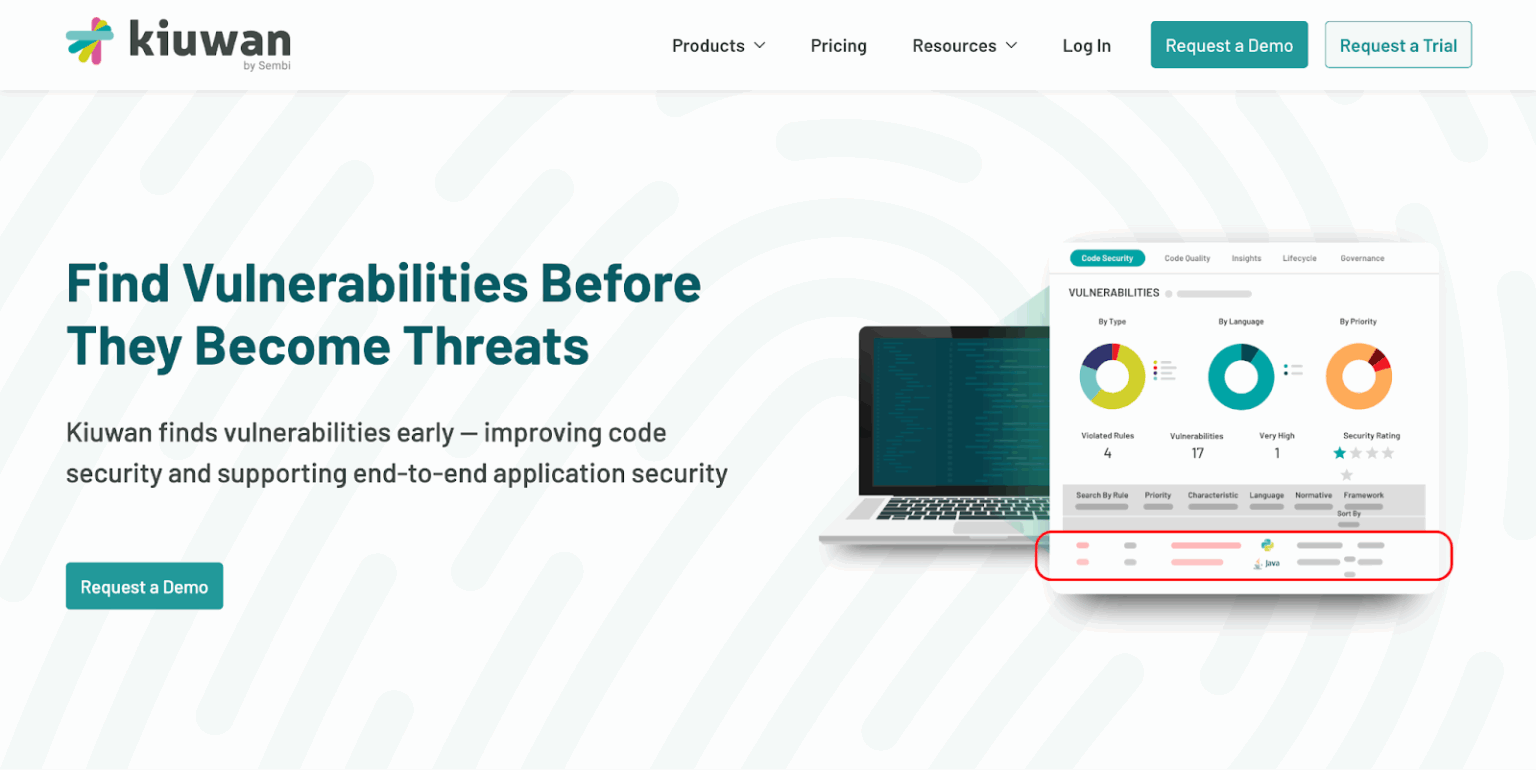
Overview:Kiuwan gives development teams a full picture of their software’s security and composition by combining SAST and SCA in one platform. With its SBOM export feature, teams can easily generate detailed, standards-compliant reports in SPDX or CycloneDX formats — perfect for meeting regulatory and customer requirements. Kiuwan fits right into existing CI/CD pipelines and offers real-time guidance for fixing vulnerabilities, so teams can move fast without sacrificing compliance.
Pros: Deep integration with development tools, automatic SBOM generation, multi-format support, and continuous vulnerability tracking across the software lifecycle.
Cons: SBOM export available only through SCA module, ensuring results remain accurate and security-focused rather than fragmented.
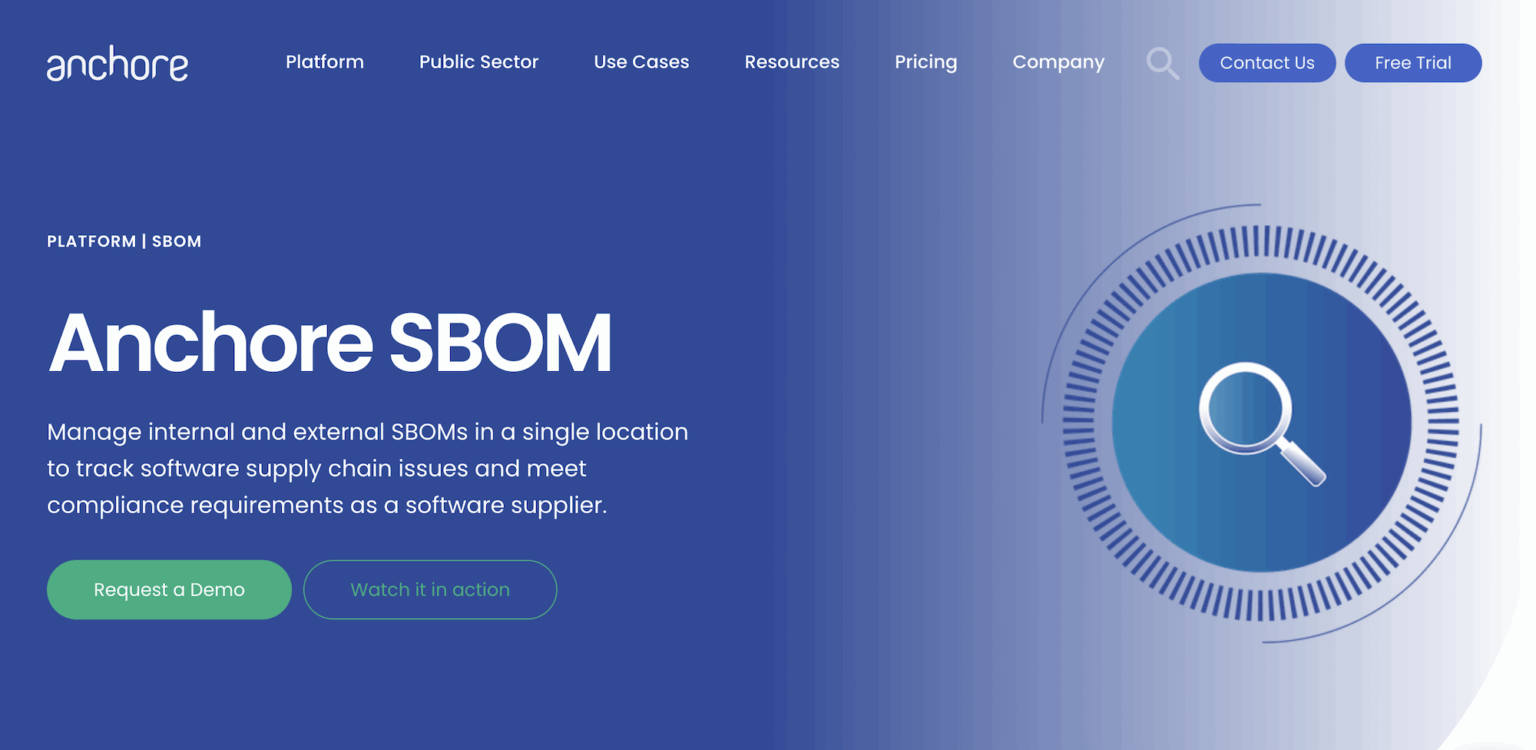
Overview:Anchore Syft scans container images and filesystems to create accurate SBOMs in multiple formats. It’s widely adopted for its simplicity and compatibility with modern DevOps pipelines.
Pros: Easy to use, supports multiple languages, and integrates smoothly with Grype for vulnerability scanning.
Cons: Limited analytics features compared to enterprise solutions.
FOSSA: License compliance and open-source visibility
Overview:FOSSA focuses on open-source license tracking and risk management, offering automated SBOM generation to ensure every dependency is accounted for.
Pros: Excellent license detection, strong compliance reporting, and developer-friendly UI.
Cons: Security analysis features are less advanced than dedicated SCA tools.
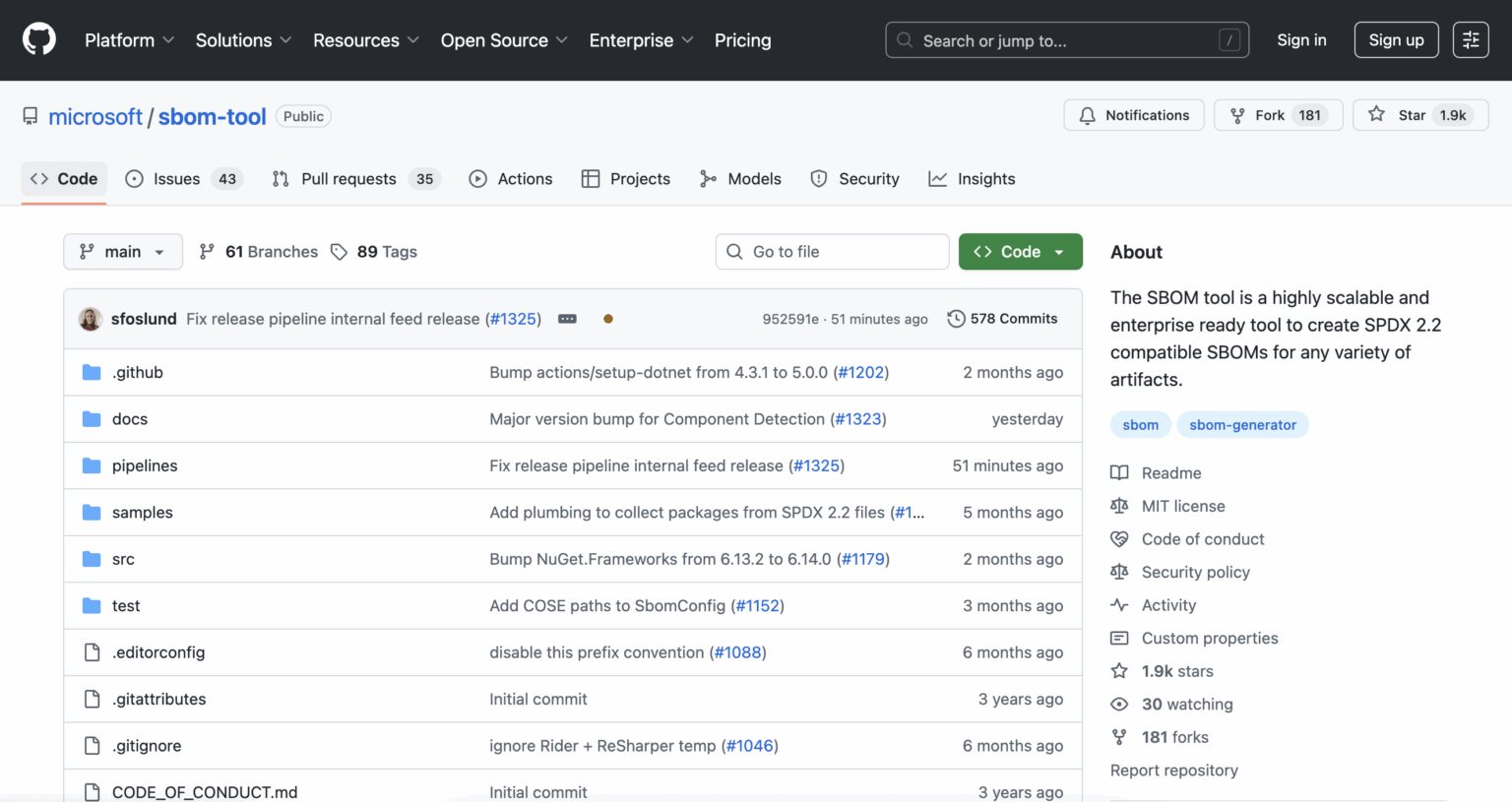
GitHub SBOM Tool: Native for GitHub repositories
Overview:Developed by Microsoft, this tool integrates directly into GitHub workflows to automate SBOM creation during code builds.
Pros: Ideal for developers already using GitHub Actions, with fast setup and open-source transparency.
Cons: Limited to GitHub ecosystem and lacks deeper vulnerability correlation features.
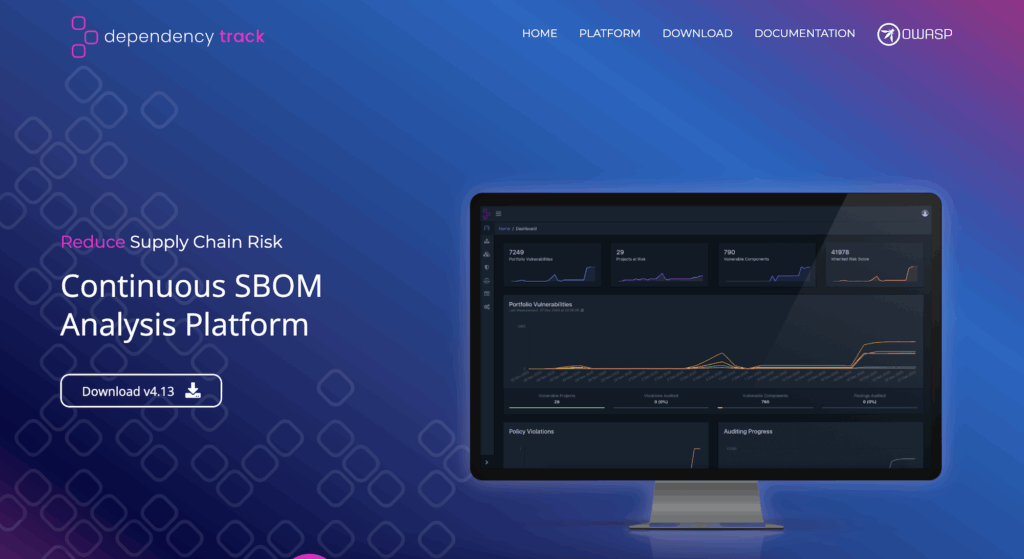
Overview:Dependency-Track analyzes SBOMs to continuously monitor for new vulnerabilities and policy violations. It works seamlessly with CycloneDX files.
Pros: Strong vulnerability detection, open-source, and suitable for large-scale environments.
Cons: Requires setup and ongoing maintenance effort for best results.
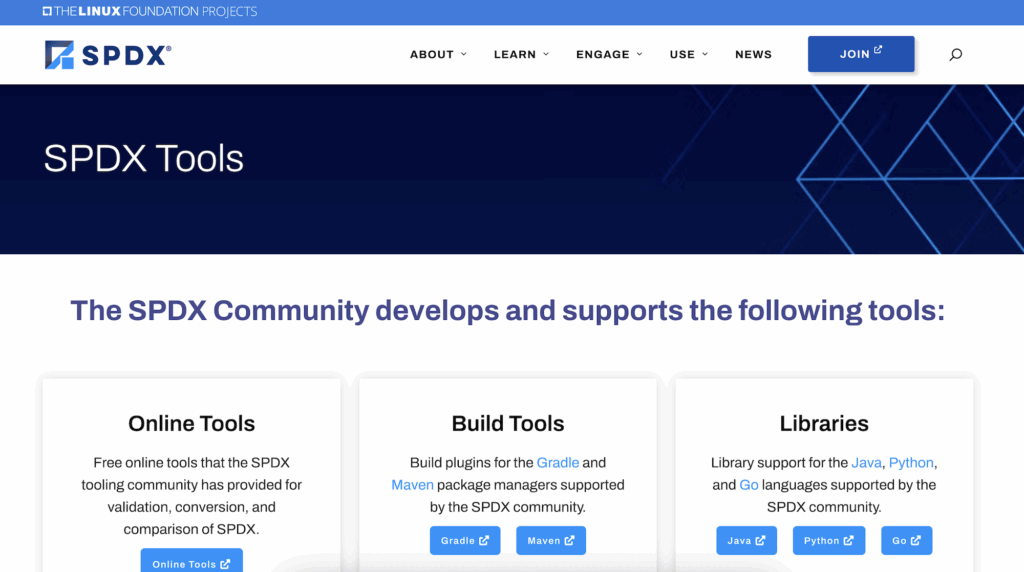
SPDX Tools: Industry-standard for compliance tracking
Overview:SPDX Tools provide utilities for creating, validating, and consuming SBOMs in the SPDX format, making it the go-to for license auditing.
Pros: Trusted standard, detailed license support, and strong community backing.
Cons: Lacks advanced UI or analytics capabilities found in enterprise products.
Wiz SBOM Generator: Cloud-native and compliance-ready
Overview:Wiz’s SBOM capabilities are built into its cloud security platform, enabling organizations to map and manage software components across hybrid environments.
Pros: Excellent for large enterprises with complex cloud deployments, strong visualization and compliance tools.
Cons: Premium pricing may limit accessibility for smaller teams.
Tool
Best for
SBOM Formats Supported
Notable Strength
Type
Kiuwan
All-in-one security and compliance
SPDX, CycloneDX
Integrated SAST + SCA with automated SBOM export
Enterprise
Anchore Syft
DevOps teams and open-source users
SPDX, CycloneDX
Lightweight, fast scanning
Open source
FOSSA
License management and compliance
SPDX
Deep license visibility and compliance reports
Enterprise
GitHub SBOM Tool
GitHub-based development teams
SPDX, CycloneDX
Native CI/CD integration
Open source
OWASP Dependency-Track
Security monitoring at scale
CycloneDX
Continuous vulnerability tracking
Open source
SPDX Tools
Legal and compliance auditing
SPDX
Global standard and strong community support
Open source
Wiz SBOM Generator
Enterprise cloud environments
CycloneDX
Unified cloud visibility and compliance mapping
Enterprise
How Kiuwan simplifies SBOM generation and strengthens software security
Real software security starts with seeing what’s really in your code. Kiuwan makes that easy.
Its built-in SCA module automatically creates SBOMs in SPDX and CycloneDX formats, so your team always knows which dependencies you’re using, what licenses they carry, and where vulnerabilities might hide. With Kiuwan, SBOM generation occurs naturally as part of the development process, not as a last-minute chore.
What that means for your team:
SBOMs are generated automatically as code evolves
Vulnerabilities are identified early in the CI/CD cycle
Compliance reporting aligns with modern security standards
Development and security teams share a single source of truth
It becomes one less thing to chase down at release time, and one more reason your software ships secure.
An SBOM tool automatically creates a software bill of materials—a detailed list of all components, dependencies, and licenses in your software. It helps teams identify vulnerabilities, track open-source usage, and ensure compliance with industry regulations.
How do SBOM tools improve software supply chain security?
SBOM tools increase transparency by showing exactly what’s inside your code. When new vulnerabilities are discovered, they help security teams identify and patch affected components faster, reducing risk exposure across the supply chain.
What’s the difference between SPDX and CycloneDX?
SPDX focuses on license compliance and documentation, while CycloneDX centers on vulnerability tracking and security visibility. Many organizations use both formats to meet compliance and security requirements simultaneously.
How do SBOM tools integrate into DevSecOps workflows?
Most modern SBOM tools integrate directly into CI/CD pipelines, automatically generating SBOMs during builds or scans. This ensures security checks and compliance reporting happen continuously, not just at release time.
Are SBOMs required for compliance with government or industry regulations?
Yes. Executive Order 14028, NIST guidance, and other frameworks increasingly require SBOMs for federal procurement and software vendors. Many private enterprises now follow the same standards to strengthen supply chain security.
What types of software can SBOM tools analyze?
SBOM tools can scan source code, binaries, container images, and even infrastructure-as-code. Some advanced tools also support cloud-native components, APIs, and third-party integrations.
What are the benefits of automating SBOM generation?
Automation saves time, eliminates manual errors, and ensures every software release includes an up-to-date inventory of components. It also helps teams maintain real-time visibility across all applications and environments.
How do SBOM tools work with SCA and SAST solutions?
SCA tools identify vulnerabilities in open-source dependencies and can export SBOMs directly. SAST tools complement this by analyzing proprietary code for security issues. Together, they provide a full picture of software risk.
What are the top features to look for in an SBOM tool?
Look for multi-format support (SPDX, CycloneDX), CI/CD integration, vulnerability correlation, license detection, export automation, and compatibility with compliance frameworks like NIST and ISO.
How can organizations get started with SBOM implementation?
Start by selecting an SBOM tool that fits your environment—open-source or enterprise—and integrate it into your build process. Begin generating SBOMs for key applications first, then expand coverage as your DevSecOps processes mature.
{
“@context”: “https://schema.org”,
“@type”: “FAQPage”,
“mainEntity”: [
{
“@type”: “Question”,
“name”: “What is an SBOM tool and why is it important?”,
“acceptedAnswer”: {
“@type”: “Answer”,
“text”: “An SBOM tool automatically creates a Software Bill of Materials—a detailed list of all components, dependencies, and licenses in your software. It helps teams identify vulnerabilities, track open-source usage, and ensure compliance with industry regulations.”
}
},
{
“@type”: “Question”,
“name”: “How do SBOM tools improve software supply chain security?”,
“acceptedAnswer”: {
“@type”: “Answer”,
“text”: “SBOM tools increase transparency by showing exactly what’s inside your code. When new vulnerabilities are discovered, they help security teams identify and patch affected components faster, reducing risk exposure across the supply chain.”
}
},
{
“@type”: “Question”,
“name”: “What’s the difference between SPDX and CycloneDX?”,
“acceptedAnswer”: {
“@type”: “Answer”,
“text”: “SPDX focuses on license compliance and documentation, while CycloneDX centers on vulnerability tracking and security visibility. Many organizations use both formats to meet compliance and security requirements simultaneously.”
}
},
{
“@type”: “Question”,
“name”: “How do SBOM tools integrate into DevSecOps workflows?”,
“acceptedAnswer”: {
“@type”: “Answer”,
“text”: “Most modern SBOM tools integrate directly into CI/CD pipelines, automatically generating SBOMs during builds or scans. This ensures security checks and compliance reporting happen continuously, not just at release time.”
}
},
{
“@type”: “Question”,
“name”: “Are SBOMs required for compliance with government or industry regulations?”,
“acceptedAnswer”: {
“@type”: “Answer”,
“text”: “Yes. Executive Order 14028, NIST guidance, and other frameworks increasingly require SBOMs for federal procurement and software vendors. Many private enterprises now follow the same standards to strengthen supply chain security.”
}
},
{
“@type”: “Question”,
“name”: “What types of software can SBOM tools analyze?”,
“acceptedAnswer”: {
“@type”: “Answer”,
“text”: “SBOM tools can scan source code, binaries, container images, and even infrastructure-as-code. Some advanced tools also support cloud-native components, APIs, and third-party integrations.”
}
},
{
“@type”: “Question”,
“name”: “What are the benefits of automating SBOM generation?”,
“acceptedAnswer”: {
“@type”: “Answer”,
“text”: “Automation saves time, eliminates manual errors, and ensures every software release includes an up-to-date inventory of components. It also helps teams maintain real-time visibility across all applications and environments.”
}
},
{
“@type”: “Question”,
“name”: “How do SBOM tools work with SCA and SAST solutions?”,
“acceptedAnswer”: {
“@type”: “Answer”,
“text”: “SCA tools identify vulnerabilities in open-source dependencies and can export SBOMs directly. SAST tools complement this by analyzing proprietary code for security issues. Together, they provide a full picture of software risk.”
}
},
{
“@type”: “Question”,
“name”: “What are the top features to look for in an SBOM tool?”,
“acceptedAnswer”: {
“@type”: “Answer”,
“text”: “Look for multi-format support such as SPDX and CycloneDX, CI/CD integration, vulnerability correlation, license detection, export automation, and compatibility with compliance frameworks like NIST and ISO.”
}
},
{
“@type”: “Question”,
“name”: “How can organizations get started with SBOM implementation?”,
“acceptedAnswer”: {
“@type”: “Answer”,
“text”: “Start by selecting an SBOM tool that fits your environment—open-source or enterprise—and integrate it into your build process. Begin generating SBOMs for key applications first, then expand coverage as your DevSecOps processes mature.”
}
}
]
}
Get Your FREE Demo of Kiuwan Application Security Today!
Identify and remediate vulnerabilities with fast and efficient scanning and reporting. We are compliant with all security standards and offer tailored packages to mitigate your cyber risk within the SDLC.
We’re announcing a new native integration between Kiuwan and TestRail that brings security and quality into the same workflow. With this release, Kiuwan users can push Static Application Security Testing…
Understanding and tracking security data breaches Security data breaches are one of the biggest challenges organizations face today. Every year, companies deal with data leaks, ransomware attacks, or unauthorized access…
How to Prevent Reverse Shell Attacks: Detection, Defense, and Best Practices TL;DR: A reverse shell attack happens when an attacker uses your system to initiate an outbound connection back to…