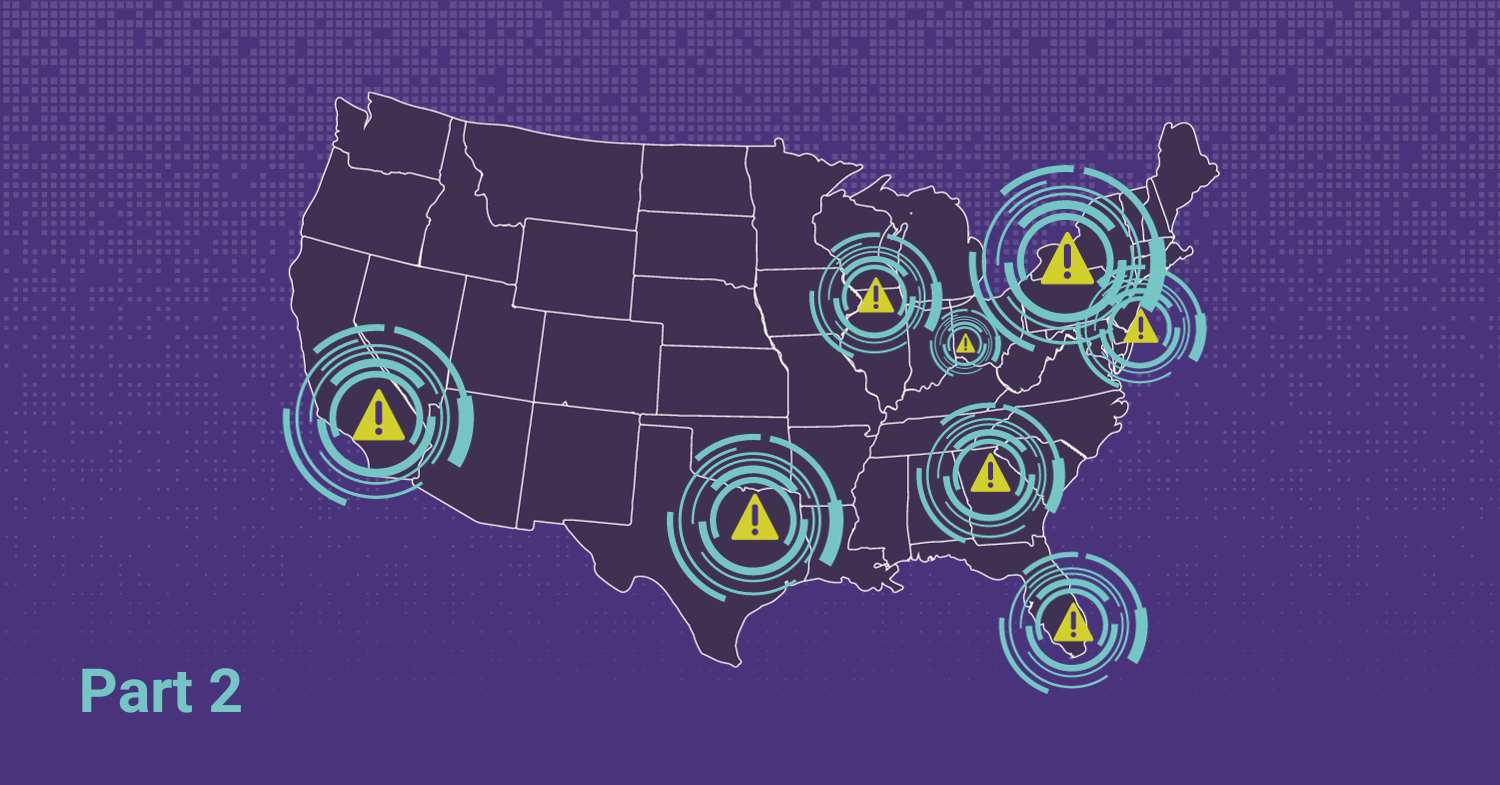
The United States of America is home to some of the world’s most sophisticated and advanced software ecosystems. As such, it is a prime target for modern cybersecurity challenges, such as hacks and data breaches. Regional cyber statistics from Verizon indicate that the U.S. (including Canada) accounted for over 68 percent of all global cyber hacks in 2023. Therefore, it’s imperative to tackle software security at the state level to enhance enterprise software protection in America.
This article will examine software security in Texas, Georgia, and New Jersey. It will examine the most prevalent software attack vectors and software security innovations, such as Kiuwan, that organizations can implement.
⚠️ Texas Cyber Incidents
Texas hosts numerous businesses from diverse industries, including information technology, oil and energy, biomedical research, and defense. Since all these industries are highly significant to the economy and handle vast amounts of sensitive data, it’s no surprise that the Lone Star State is grappling with many software security challenges.
Fort Worth Hack
In June 2023, the hacktivist group SiegedSec hacked Vueworks, an application for managing maintenance work orders for various departments in Fort Worth. Shortly after, the city issued a press release stating that the hackers had infiltrated the system, downloaded internal data, and posted it online as a protest against Texas’s ban on gender-affirming care.
According to city officials, investigations determined that the group gained unauthorized access to the system by obtaining login credentials. While they did leak some data, it wasn’t sensitive, and they did not manage to access any other systems. In response to the incident, the city took the precautionary measure of removing the system from the external internet and forcing all users to reset their passwords.
New Front Attack
On 16th August 2019, a ransomware attack saw hackers infiltrate the computer systems of 22 municipalities in Texas. In exchange for restoring access to the compromised systems, the hackers demanded a $2.5 million ransom. While the cities did not pay a single cent to the hackers, Texas is estimated to have spent around $12 million to resolve the attack.
According to the Texas Department of Information Resources (DIR), within a few hours of discovering the ransomware attacks, the state, in coordination with federal teams, had already created and implemented a response plan. The cybersecurity teams conducted an initial evaluation of the affected municipalities, focusing on providing immediate assistance to those in the most urgent need. By the fourth day following the attacks, the DIR reported that cyber response teams had completed over 25 percent of the response activities across all affected municipalities. Soon after, all the essential business services were successfully reinstated.
⚠️ Georgia Software Breaches
Home to Atlanta, fondly known as the “Silicon Peach,” Georgia has become a hub for enterprise software development. This growth has not gone unnoticed by malicious actors seeking to exploit vulnerabilities.
USG MOVEit Hack
In June 2023, the University System of Georgia (USG) experienced a data breach that exposed the personal information of its students and staff. According to USG, the breach occurred due to a vulnerability in MOVEit, a software application used to store and transmit sensitive information. This vulnerability enabled unauthorized parties to access MOVEit servers, ultimately making USG a target for malicious actors.
After identifying the breach’s source, USG promptly patched the software. It also revealed that it was actively monitoring communications with Progress Software, the provider of MOVEit.
PBI Research Services Data Breach
Still linked to the MOVEit software, in 2023, PBI research services experienced a data breach that exposed data stored by the Georgia Teachers Retirement System (TRS). According to TRS, a vulnerability in MOVEit allowed hackers to access the data of over 261,697 university faculty, retired Georgia teachers, and beneficiaries.
Immediately after identifying the hack, PBI took immediate action. They informed all affected individuals and established a dedicated call center for their members. Additionally, PBI recommended that its members take protective measures, such as reviewing their credit reports and implementing two-factor authentication for their online accounts.
⚠️ New Jersey Digital Threats
New Jersey has also had its fair share of security threats. One of the highest-profile breaches in this state is the myNewJersey portal breach. In 2021, hackers targeted and compromised the myNewJersey software application, a portal that allows users to access information, such as payroll and tax records, using a single ID and password. According to reports, the hackers accessed the portal using compromised login credentials from the dark web. They accessed the personally identifiable information of over 200 state employees, including pension information, Social Security numbers, phone numbers, names, email addresses, and birthdays.
✔️ Lessons Learned and the Importance of Robust Software Security Measures
Cybersecurity in business is paramount. If not implemented strategically, devastating consequences can arise, including financial losses, reputational damage, and operational disruptions. Moreover, the incidents highlighted in our software security-by-state analysis reveal several lessons organizations can learn.
For one, organizations must understand that vulnerabilities are everywhere. The incidents in the states discussed highlight vulnerabilities in all types of software applications, even those used by government agencies and educational institutions. This underscores the need for a comprehensive software security approach that involves continuous vulnerability analysis and patching. This also means having a comprehensive security strategy in place. This plan should outline steps to be taken in the event of a breach, ensuring a well-coordinated response. For instance, prompt response is vital in mitigating the impact of the incidents once identified. Identifying and containing the breach quickly can prevent further damage and help reduce financial and legal implications.
🚀 Kiuwan: The Frontline Defense for Software Security
Software security isn’t a one-time thing; it’s a continuous process that should start from the earliest stages of application development and persist throughout the software’s lifecycle. One key element of this ongoing process is the use of robust code security tools. Kiuwan is a leading application security testing and code analysis platform that offers several features to help organizations avoid launching applications with vulnerabilities waiting to be exploited.
We have two main solutions: Static Application Security Testing (SAST) and Software Composition Analysis (SCA). With SAST, Kiuwan conducts an in-depth source code vulnerability analysis during the development phase. On the other hand, Kiuwan SCA enables organizations to analyze and monitor third-party components used in their applications, thereby enhancing overall security by addressing vulnerabilities in those components. Sign up for a free trial today to enhance your software security.