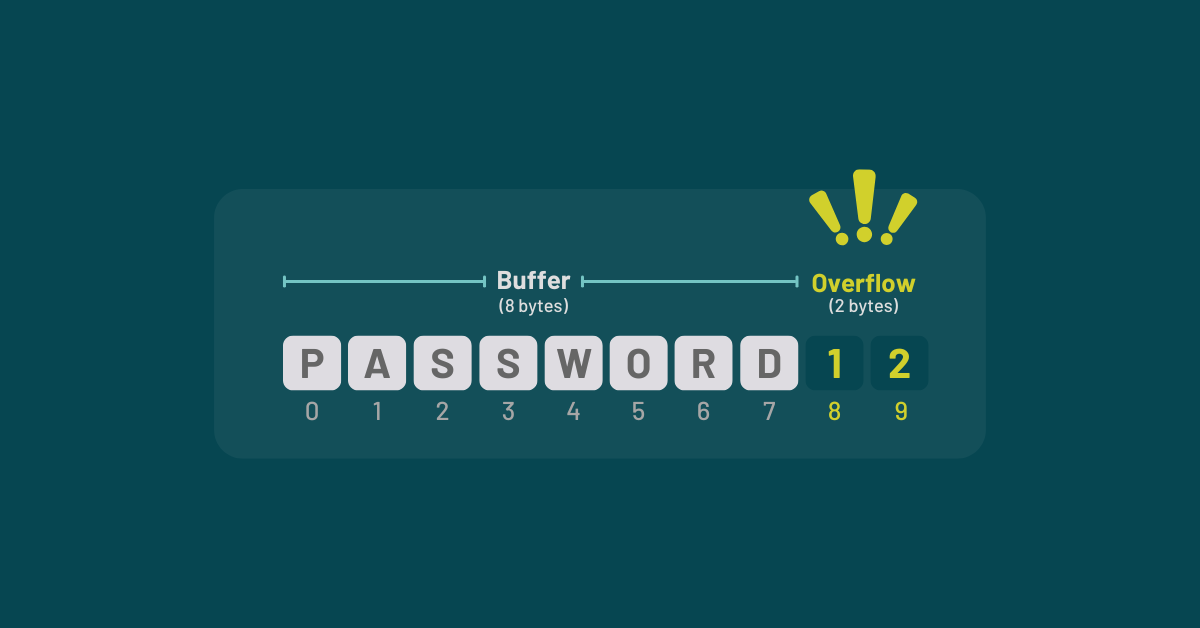
A buffer overflow attack is a common vulnerability in software security. It happens when a program writes more data into a memory buffer than it can hold, causing data corruption, crashes, or even remote code execution.
Buffer overflows have been known for decades. They still pose a serious risk, especially in C and C++ systems that rely on manual memory management. If teams don’t quickly fix buffer overflow issues, the organization could face big problems. These may include severe business impacts, from legal penalties and fines to lost trust and revenue.
This guide explains how buffer overrun attacks work, their consequences, and real-world examples. You’ll also learn how modern cybersecurity tools like Kiuwan help teams detect and prevent them before deployment.
What is a buffer overflow?
In programming, a buffer is a block of memory set aside to hold data, such as strings, arrays, and user inputs. Buffers have fixed boundaries, but when more data is written than the buffer can hold, the excess spills into adjacent memory. This is called a buffer overflow.
Here’s a C program with a buffer that holds just 10 bytes.
char buffer[10];
// Unsafe: input exceeds buffer size
strcpy(buffer, “This input is way too long!”);
Note that it uses strcpy, which is unsafe. This function copies a longer string without checking the bounds. Extra characters overwrite nearby memory, which can corrupt program behavior, cause crashes, or trigger a segmentation fault—an error that happens when a program tries to access memory it shouldn’t.
To stay safe, replace unsafe functions like strcpy with bounded alternatives such as strncpy. Keep in mind, though, that even strncpy has pitfalls—for example, it doesn’t always null-terminate strings. CERT recommends using safer functions like strlcpy or strnlen_s, or relying on memory-safe abstractions where possible.
What is a buffer overflow attack?
A buffer overflow attack occurs when a threat actor sends too much input. This oversized input causes an overflow, allowing them to take control of the program.
Threat actors target buffer overflows because they can do more than crash web applications and systems. These vulnerabilities can result in major security issues, such as denial-of-service (DoS), remote code execution (RCE), and privilege escalation.
Hackers can use buffer overflows to take control of operating systems. They overwrite key memory areas like executable code and function pointers. This allows them to perform unauthorized actions.
Buffer overflow consequences
Buffer overflow cyberattacks can have mild or severe effects. It all depends on how the attackers use them.
- System crashes and downtime: Applications stop responding, leading to outages and productivity loss.
- Remote code execution (RCE): Attackers inject and run any code using the application’s privileges.
- Privilege escalation: Exploits let attackers gain root or admin access, widening the scope of compromise.
- Data corruption and leaks: Sensitive information, including keys, passwords, and personally identifiable information (PII), can be exposed. Not following standards like the Health Insurance Portability and Accountability Act (HIPAA), the General Data Protection Regulation (GDPR), or the Payment Card Industry Data Security Standard (PCI DSS) can incur fines, legal issues, and damage to your reputation. Consequently, this could hurt your profits.
Crashes aren’t just a hassle for companies and their stakeholders. They can also put lives at risk, especially in high-stakes industries. For example, a buffer overflow in medical devices can cause an insulin pump to fail, which could endanger lives. Similarly, in the aerospace industry, a failure in avionics software can threaten flight safety.
Buffer overflow attack examples
Buffer overflow security vulnerabilities are among the oldest and most common software vulnerabilities. Here’s a summary of the most well-known ones.
Morris Worm (1988)
- One of the first major internet worms, the Morris Worm, exploited a stack buffer overflow in the Unix “finger” service, among other flaws. It infected about 6,000 machines—nearly 10% of the internet at the time—including systems at major universities and government labs.
- Takeaway: This attack demonstrated how quickly buffer overflows could be weaponized and why secure coding practices are critical, even in research environments.
Code Red (2001)
- The Code Red worm spread through a buffer overflow in Microsoft Internet Information Services (IIS). By sending a long string of “N” characters, it overwrote memory and allowed the worm’s code to run. Within days, over 350,000 hosts were infected worldwide, overwhelming networks and enterprise systems.
- Takeaway: Code Red underscored the importance of timely patching and proactive monitoring of widely deployed enterprise software.
SQL Slammer (2003)
- SQL Slammer exploited a buffer overflow in Microsoft SQL Server’s Resolution Service. Despite a patch being available six months earlier, the worm spread rapidly, doubling its reach every few seconds and disrupting global internet traffic. Banks, airlines, and emergency services all reported outages.
- Takeaway: Slammer proved how quickly unpatched vulnerabilities can escalate into global crises—and reinforced the need for disciplined patch management.
Heartbleed (2014)
- Heartbleed was a critical flaw in OpenSSL’s TLS implementation, caused by missing bounds checks in the heartbeat extension. It allowed attackers to read private memory, exposing encryption keys and sensitive data. Institutions like the Canada Revenue Agency and Mumsnet suffered breaches before OpenSSL released a fix.
- Takeaway: While technically a bounds-check vulnerability rather than a classic buffer overflow, Heartbleed highlighted how a single memory-handling error in a widely used library can endanger millions of users.
How buffer overflow attacks work
When threat actors create input to trigger an overflow, it can lead to serious issues. These include data leaks, fines, and lawsuits. Here are the types of buffer overflow attacks and threat actor exploitation techniques to be aware of.
Types of buffer overflow attacks
Types of buffer overflows include:
Stack-based buffer overflows
Stack-based buffer overflows are the most common form of overflow vulnerability. They happen when a program writes more data to a buffer on the stack than what the buffer allows. This often corrupts nearby data on the stack. As a result, the program might crash or run incorrectly. Such flaws are frequently introduced by unsafe functions like strcpy when the destination buffer is too small for the source input. A crash usually happens, but if an attacker controls the input, they can change the return address. This lets them send execution to harmful code and take over the program.
Heap-based buffer overflows
Heap-based buffer overflows happen when a buffer in the heap memory is overwritten, usually due to a lack of bounds checking. They can lead to software vulnerabilities and crashes because threat actors modify the program’s memory space beyond its intended boundaries. Compared to stack-based overflows, heap overflows are more complex to exploit. Organizations can prevent these vulnerabilities by implementing proper bounds checking and memory management.
Off-by-one buffer overflows
Off-by-one buffer overflows happen when a program writes one byte past a buffer’s limit. This usually occurs due to miscalculating the needed space. For instance, a programmer might forget to include a terminating character like “\0” in C strings. This single-byte overrun can change a nearby byte. This corrupts important control data and lets attackers redirect execution. Organizations can stop off-by-one overflows by:
- Enforcing strict bounds checking in code reviews
- Using safe string-handling functions
- Applying compiler protections, like stack canaries and address sanitizers, during development
Exploitation techniques: How do attackers exploit buffer overflows?
Attackers look for buffer overflows. Once they find one, they exploit the memory issue to run their code. Common exploitation techniques include:
Return address manipulation
Attackers change the return address. This is the memory spot where the program continues after a function call. They replace it with an address they choose. They can then inject malicious code using the methods below.
Shellcode injection
After taking over an address by changing the return address, attackers inject shellcode. This malicious code opens a command shell on the target system, allowing the attacker to gain control and carry out harmful actions.
NOP sleds or ramps
These are sequences of NOP instructions put at the beginning of code sections. Their goal is to “slide” the CPU’s instruction execution flow to whatever the attacker wants.
Heap spraying
A threat actor injects harmful data into the memory heap. This makes the execution flow jump to the sprayed memory instead of the original code. The heap memory stores all the variables created at runtime.
Return-oriented programming (ROP)
ROP is a clever attack method that lets hackers run code even if strong security measures are in place, like code signing and executable space protection. Attackers attach small pieces of attack code to the stack. Then, they overwrite the return address with this new location.
These exploitation techniques continue to evolve in tandem with defensive measures. Even with protections like stack canaries, ASLR, and DEP, attackers still find clever ways to get around them. Accordingly, organizations must invest in static and dynamic defense.
Who is vulnerable to buffer overflow attacks?
Buffer overflows can be a serious threat in industries that rely on legacy systems and low-level code. These include:
- Embedded systems and IoT devices that use basic hardware, which means they run firmware written in memory-unsafe languages like C or C++.
- Medical devices, industrial control systems, and aerospace software have slow patch cycles that are easier to hijack.
- Organizations with legacy C/C++ code, like those in defense, telecommunications, and finance, face the challenge of retrofitting modern protections into old software.
Which programming languages are most vulnerable?
C and C++ are especially prone to buffer overflow attacks. They use manual memory management, so there’s no automatic bounds checking. Developers have complete control over performance. However, threat actors can easily introduce memory errors without being noticed.
Modern memory-safe languages, like Python, Java, Go, and Rust, automatically check bounds and hide direct pointer manipulation. As such, they are much less likely to be vulnerable to buffer overflow attacks. However, they can still be affected by bugs, for example, in the Java Virtual Machine.
How to prevent buffer overflows
You can prevent buffer overflows by adopting secure coding practices such as:
- Input validation and bounds checking: Always check input length before writing it into a buffer.
- Safe library and application programming interfaces (APIs): Replace functions like strcpy with safer alternatives such as strncpy, fgets, or memory-safe abstractions.
- Compiler flags: Enable Data Execution Prevention (DEP), stack canaries, and Address Space Layout Randomization (ASLR) to make exploitation more difficult.
- Stack canaries: These are small, randomized values that you can insert between a buffer and its return address on the stack. If an overflow overwrites the canary, the program detects the mismatch and aborts before attackers can hijack the execution.
How Kiuwan helps mitigate buffer overflow attacks
Preventing buffer overflows is tough. This is particularly true when watching for other software vulnerabilities and having a large attack surface. That’s where Kiuwan Code Security (SAST) comes in.
As a cloud-based application security platform, Kiuwan helps you find and fix buffer overflow risks. Here’s how:
- Spots unsafe functions and unsanitized inputs: Kiuwan SAST quickly finds code vulnerabilities that could cause buffer overflow attacks. This lets your team act before these issues turn into breaches.
- Supports compliance: Kiuwan Code Security supports compliance with major security standards like CWE/SANS, OWASP Top 10, and PCI-DSS. It gives detailed reporting to help your team meet these compliance requirements during development. That way, your apps align with industry best practices.
- Integrates into CI/CD: Kiuwan Code Security runs automatic vulnerability scans within your continuous integration and continuous delivery/deployment (CI/CD) pipeline. It works smoothly with popular development tools like Visual Studio, Jenkins, and GitLab.
- Customizable rulesets: Kiuwan SAST can be fully customized to match your coding practices. As such, you can tailor checks for legacy C/C++ systems or industry-specific compliance needs.
You can detect and prevent buffer overflow vulnerabilities before they reach production. Kiuwan SAST scans C and C++ code for unsafe memory operations, flags violations against CWE standards like CWE-120, CWE-121, and CWE-122, and integrates seamlessly into your CI/CD pipeline.
Start your free trial today to see how Kiuwan helps your team eliminate critical memory risks and maintain compliance with industry standards.
Buffer overflow FAQs
Why are buffer overflows still common if they’ve been known for decades?
Buffer overflows remain common because C and C++ are still widely used in systems programming and embedded devices, and many legacy applications lack modern security protections.
Are buffer overflows relevant in memory-safe languages like Rust?
Buffer overflows aren’t directly relevant in memory-safe languages like Rust, Go, and Swift. That’s because they’re designed to prevent buffer overflows by enforcing strict memory safety rules.
However, using unsafe external libraries can reintroduce buffer overflows. For example, suppose a developer uses unsafe blocks when they need low-level control, and the compiler suspends some safety checks inside these blocks. In that case, buffer overflows can creep back in if the developer isn’t careful. Additionally, if a programmer links to a C library or uses Foreign Function Interface (FFI), the app will be exposed to the same risks as C, even if the developer is working in Rust.
What compliance standards address buffer overflows?
Several compliance standards address buffer overflows. These include:
- The Common Weakness Enumeration (CWE) categorizes buffer overflows as follows: CWE-120 (Classic Buffer Overflow), CWE-121 (Stack-based Buffer Overflow), and CWE-122 (Heap-based Buffer Overflow). These classifications are widely used in vulnerability databases, static analysis tools, and security audits, giving teams a consistent way to spot and fix overflow risks.
- The CERT C Secure Coding Standard provides language-specific guidance for writing safe C and C++ code. It tells programmers to avoid unsafe functions (e.g., strcpy, gets), enforce bounds checking, and use safer alternatives. Many regulated industries, like healthcare and aerospace, follow CERT C to meet safety and compliance requirements.
- OWASP Top 10 (A06: Vulnerable and Outdated Components) While buffer overflows aren’t listed as a standalone category in the OWASP Top 10 (2021), they are implicitly covered under multiple categories. If an application depends on unpatched libraries, they fall under A06: Vulnerable and Outdated Components. If unsafe coding practices or misconfigurations leave them exploitable, they can also be mapped to A05: Security Misconfiguration.
How do DevSecOps teams address buffer overflows?
DevSecOps teams can address buffer overflows by:
- Shifting left with tools like Kiuwan SAST to detect unsafe memory operations early in the codebase
- Enforcing secure coding practices, such as avoiding unsafe functions (strcpy, gets), and using memory-safe alternatives or languages
- Integrating automated checks into CI/CD pipelines to catch regressions and vulnerabilities before deployment